

10 October 2026


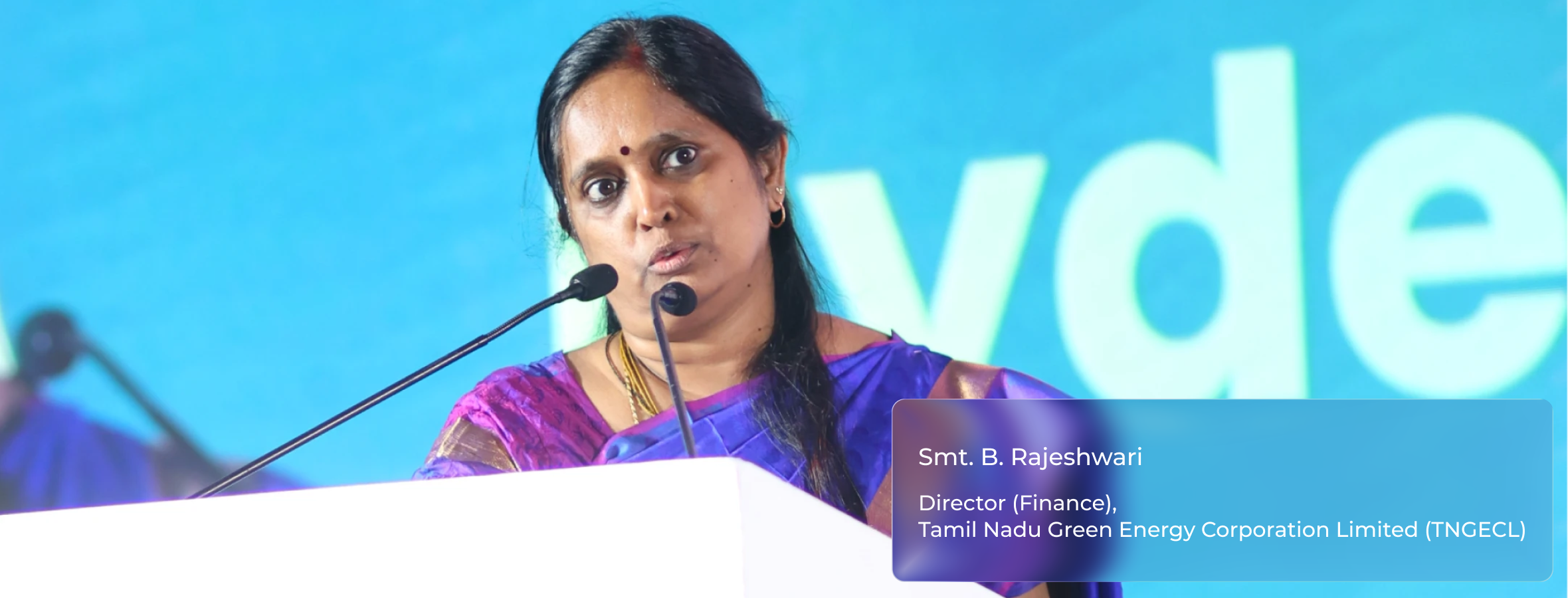
Smt. B. Rajeshwari
Director (Finance), Tamil Nadu Green Energy Corporation Limited (TNGECL)
Tamil Nadu was one of India’s earliest renewable-energy leaders.
Its next challenge is to integrate that legacy into a new energy system built around solar, wind, storage, pumped hydro, electric mobility and distributed energy.
At the Hyderabad Roadshow for Bharat Renewable Energy Summit & Expo 2026, Smt. B. Rajeshwari, Director (Finance), Tamil Nadu Green Energy Corporation Limited, outlined how the state is preparing for that next phase.
Tamil Nadu currently ranks fourth in India in renewable-energy generation, second in wind and fourth in solar, according to the figures presented in her address.
Its total renewable-energy portfolio stands at approximately 29 GW. Of this, around 14.3 GW comes from solar and approximately 12 GW from wind, with the balance contributed by small hydro, biomass and other renewable-energy sources.
Rajeshwari also placed this in a longer historical context: Tamil Nadu was an early wind pioneer and commissioned a 400 MW pumped-storage project at Kadamparai decades ago, giving the state an unusually long operating history with renewable generation and storage.
The composition itself tells an interesting story.
Tamil Nadu built its renewable leadership around wind, but solar has rapidly emerged as an equally important contributor. Rajeshwari noted that in recent months solar capacity had overtaken wind within the state’s renewable portfolio.
Policy is now being redesigned to reflect that changing reality.
Tamil Nadu previously operated separate frameworks covering areas including solar, wind repowering, small hydro and electric vehicles. The state is now moving towards an Integrated Renewable Energy Policy, bringing wind, solar, Pumped Storage Projects, battery energy storage and smaller renewable projects under a broader framework.
Storage will play an increasingly important role in this ecosystem.
The state has identified about 15 GW of pumped-storage potential and around 93 GW of wind potential. Tamil Nadu has also issued a wind-repowering policy to extract more output from an ageing fleet, much of which has been operating for around 25 years.
Rajeshwari referred to approximately 15 sites identified for pumped-storage projects, with three broad development routes: allocation to Central Public Sector Undertakings; competitive PPP-based development; and a self-identification model, under which investors can identify suitable sites and approach the government, with the state coordinating approvals including water- and forest-related clearances.
The transition also extends to electric mobility.
Tamil Nadu plans to establish 20,000 public EV charging stations over the next five years. For charging infrastructure, Rajeshwari referred to support of 25% of development charges, subject to a maximum of around Rs 10 lakh, and a separate subsidy of up to Rs 50,000 for charging facilities in residential welfare associations and gated communities.
Distributed solar is another priority.
In addition to the Central Government support available under PM Surya Ghar: Muft Bijli Yojana, Rajeshwari said Tamil Nadu has announced an additional state subsidy of Rs 5,000 for 1 kW, Rs 10,000 for 2 kW and up to Rs 22,000 for 3 kW and above.
Tamil Nadu’s renewable-energy story is consequently shifting from individual technologies towards integration.
Rajeshwari said renewable-energy consumption in Tamil Nadu is currently close to 30% against its RPO framework, with the state targeting at least 50% renewable-energy consumption by 2031.
Wind built the foundation. Solar accelerated the scale.
Storage, pumped hydro, electric mobility and distributed generation will now help determine what comes next.