

10 October 2026


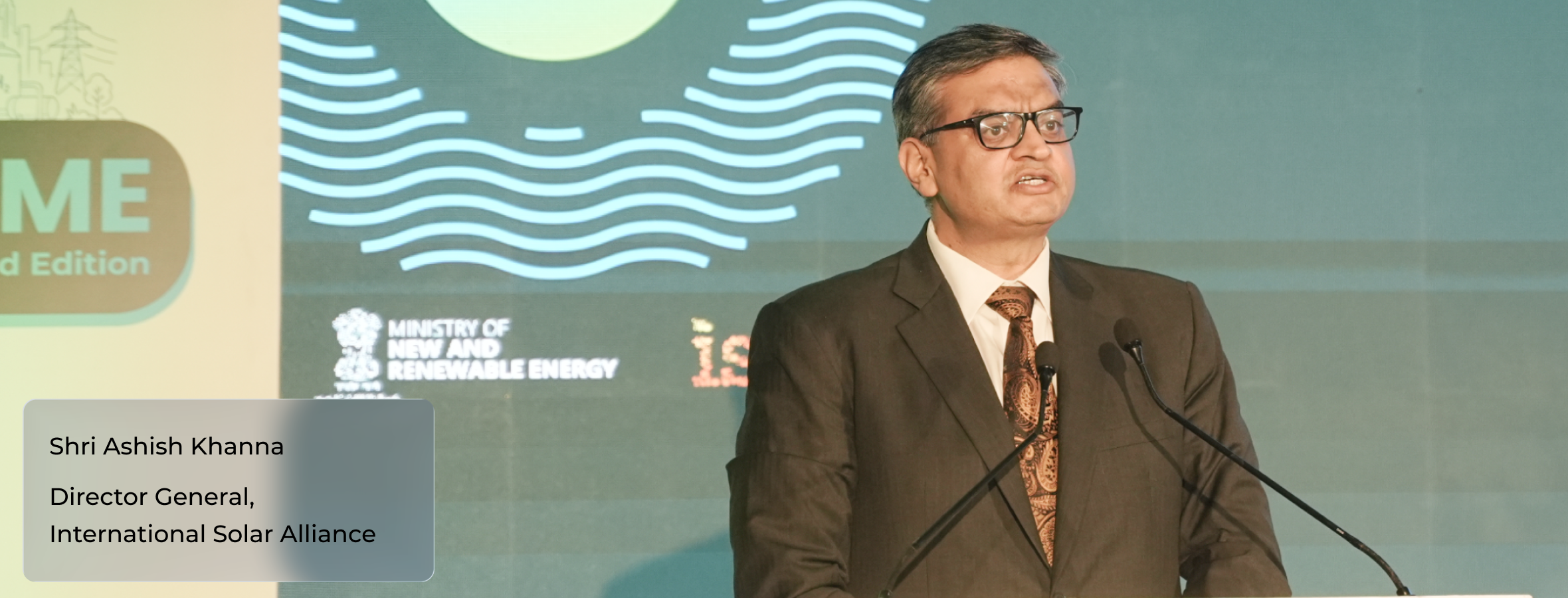
Shri Ashish Khanna
Director General, International Solar Alliance
Ten years ago, India was asking the world to participate in its renewable-energy journey.
Today, a growing part of the world is asking how India did it.
Shri Ashish Khanna, Director General, International Solar Alliance, used his address at the Ahmedabad Roadshow to describe that shift, from India as a destination for renewable-energy investment to India as a source of technologies, experience and scalable clean-energy solutions for other emerging economies.
He recalled the vision articulated for the International Solar Alliance in 2015: helping enable 1,000 GW of solar capacity globally.
At the time, the number appeared extraordinarily ambitious.
The world has now crossed approximately 3,000 GW of installed solar capacity. Meanwhile, the International Solar Alliance has expanded to 129 Member Countries, becoming a major multilateral institution for the Global South headquartered in India.
India’s own trajectory is equally significant. Khanna described India as the world’s third-largest solar market, while noting that in the previous year it had recorded the second-largest annual solar-capacity addition globally. Gujarat, with its renewable-energy and rooftop-solar ecosystem, has played an important role in that growth story.
But Khanna’s focus was firmly on what comes next: how India’s solar experience can translate into international opportunity.
Across ISA’s 129-country network, he said, countries are looking to replicate India’s experience of competitive tariffs, manufacturing and an ecosystem of local-currency financing.
The first opportunity is global market access. Khanna described Africa as being at a take-off stage comparable to where India stood six to seven years ago, with installed solar capacity of about 22 GW and ambitions to reach 150 GW by 2030 and 500 GW by 2040. He also pointed to island economies with heavy diesel dependence as natural markets for Indian rooftop-solar and clean-energy solutions.
The second opportunity is finance. Khanna highlighted ISA’s Global Solar Facility at GIFT City, Ahmedabad, where an initial $200 million investment has been initiated with African partners including Africa50 and the Nigeria Sovereign Investment Authority. The facility is intended to support private investment in areas such as solar rooftops, mini-grids and solar pumps, beginning with Africa and later extending to India and other Asian markets.
He also drew attention to the scale of institutional capital. International pension funds and sovereign wealth funds hold about $14 trillion in capital, he said, while only around 0.5% of their assets are invested in India. For developers working with 25-year PPAs, access to long-term capital can help reduce costs further and improve competitiveness.
The third opportunity is innovation. Khanna identified storage, flexible grids and AI applications for distribution management as the next wave, alongside new battery technologies such as sodium-ion and iron-based systems. His call to Gujarat was to use its entrepreneurial base not only to deploy technology, but to build startups, manufacturing capability and innovation around it.
The fourth opportunity is capacity building. ISA is already discussing with the Government of Gujarat how the state can share its experience with other countries. Khanna cited a programme to support Mauritius on solar rooftops and noted that ISA has established 17 Centres of Excellence in 17 countries, with Indian talent contributing to policy, procurement and local capability building.
His larger point was that the global solar transition will be driven substantially by private capital. Of the roughly $2 trillion invested in 2025, he said only about 5% came as net government or multilateral-bank money, while approximately 95% came from the private sector.
That is where BRE Summit 2026 and the International Solar Alliance Assembly can become practical platforms for business-to-business partnerships, investment and international deployment.
India’s solar story, in Khanna’s framing, is no longer only about scaling at home. It is about taking Indian manufacturing, finance, innovation and implementation capability into the next generation of solar markets worldwide.