

10 October 2026


The clean-energy opportunity unfolding across southern India is no longer confined to building more solar and wind capacity. It is expanding into storage, transmission, manufacturing, technology and entirely new energy value chains.
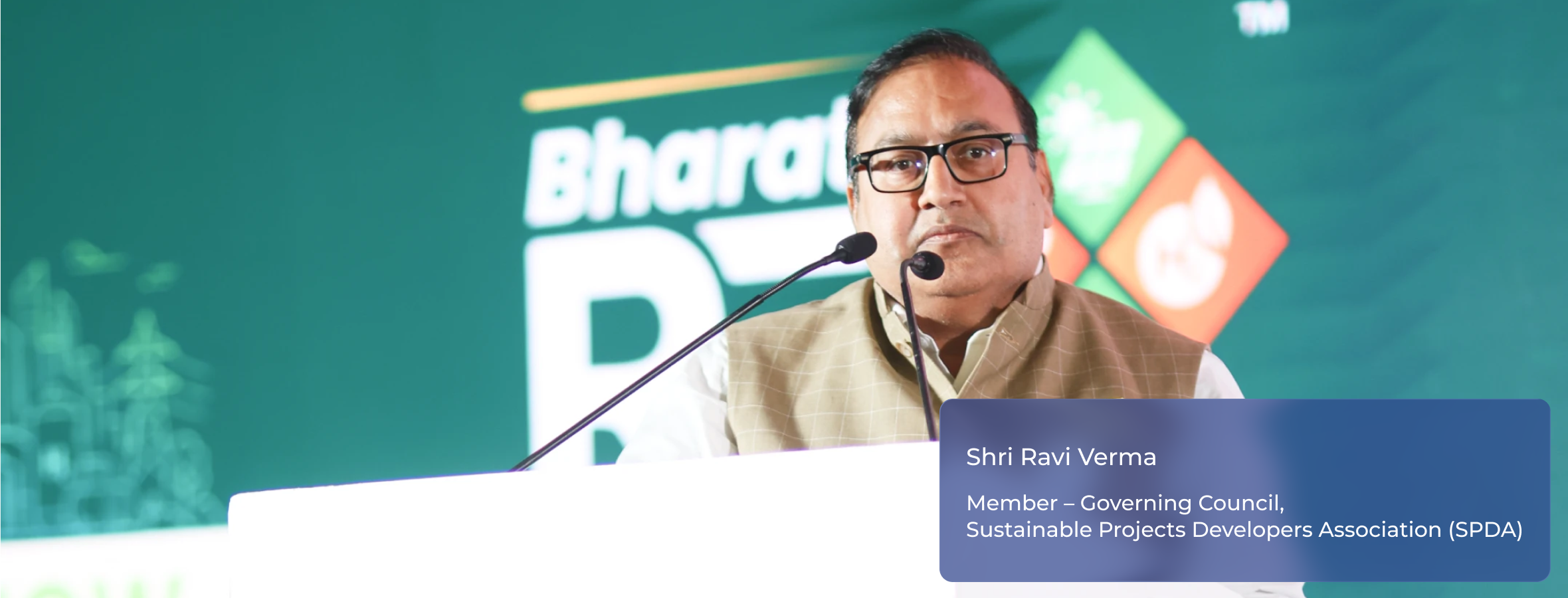
Shri Ravi Verma
Member – Governing Council, Sustainable Projects Developers Association (SPDA)
The clean-energy opportunity unfolding across southern India is no longer confined to building more solar and wind capacity. It is expanding into storage, transmission, manufacturing, technology and entirely new energy value chains.
That was the larger perspective offered by Shri Ravi Verma, Member – Governing Council, Sustainable Projects Developers Association (SPDA), as he set the context for the Hyderabad Roadshow of the Bharat Renewable Energy Summit & Expo 2026.
Verma highlighted the collective opportunity represented by Telangana, Andhra Pradesh and Tamil Nadu. The region combines established strengths in technology, manufacturing, infrastructure, pharmaceuticals and data centres with a growing demand for cleaner and more reliable energy.
For these industries, Verma said renewable energy is no longer merely an environmental objective; it is increasingly an economic and industrial activity, becoming more competitive and economical as deployment scales.
But renewable energy itself is changing.
The ecosystem can no longer be viewed simply as generating electricity through solar and wind. Verma described a shift towards an integrated energy economy encompassing storage, green-energy corridors, transmission and round-the-clock (RTC) renewable power.
Pumped Storage Projects (PSPs), particularly in Andhra Pradesh and Telangana, were highlighted as an important part of this transition, alongside battery storage, to move the system from pure solar and wind generation towards firm and RTC renewable supply.
This transition creates opportunities well beyond project development.
As renewable-energy deployment expands, so too does the opportunity for domestic manufacturing and supply-chain development. Verma linked this directly with the larger objective of Atmanirbhar Bharat, arguing that the transition should create not merely renewable-energy assets but a stronger domestic industrial ecosystem around them.
States are central to that process.
Renewable projects, manufacturing plants, transmission infrastructure and investments ultimately take shape within states. Policies created by the Centre and state governments must therefore work together to create environments in which capital, developers and technology providers can participate at scale.
That is also why platforms such as BRE Summit 2026 matter.
Verma envisaged the Summit as a place where government leaders, innovators, technology providers, academia and industry can meet, examine emerging technologies, discuss investment and create business opportunities.
The Hyderabad Roadshow demonstrated the possibilities already emerging across Telangana, Andhra Pradesh and Tamil Nadu.
The next step is to connect those possibilities into an integrated clean-energy economy.