

10 October 2026


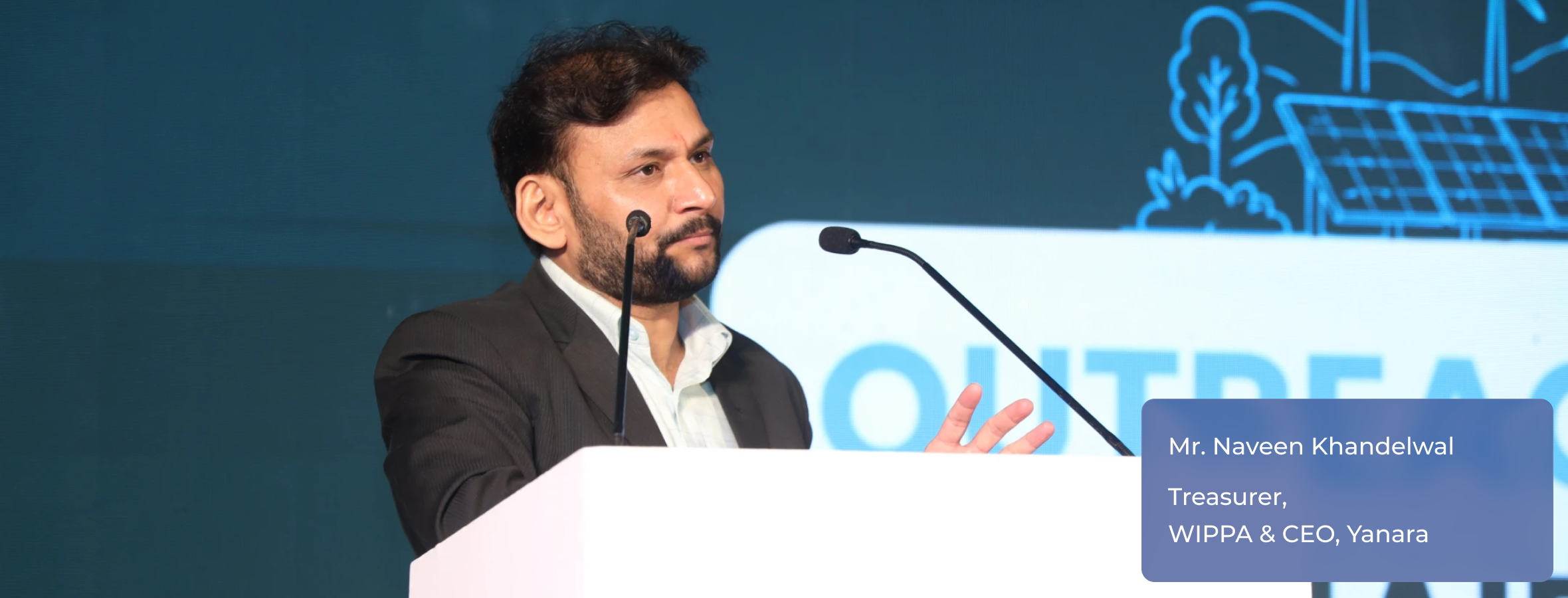
Mr. Naveen Khandelwal,
Treasurer,
WIPPA & CEO, Yanara
For Mr. Naveen Khandelwal, the Jaipur Outreach Programme was both a precursor to BRE Summit 2026 and a chance to examine how Rajasthan has become one of the most recognisable centres of India’s renewable-energy build-out.
He placed the forthcoming Summit within the longer RE-INVEST journey—from the first edition in 2015, through 2018, the virtual 2020 edition with more than 20,000 participants, and the 2024 edition in Gandhinagar—to the fifth edition at Bharat Mandapam in November 2026.
Rajasthan, he said, has already crossed 50 GW of renewable capacity, with more than 44 GW of solar. Places such as Bhadla, Bikaner and Pokhran have moved from being known primarily as desert geographies to becoming familiar names in the global renewable-investment conversation. The state’s next target is 125 GW by 2030.
That target, Khandelwal stressed, will not be delivered by solar alone. He described a portfolio that includes wind, battery energy storage, hydro, biogas and biomass. Rajasthan’s wind capacity is approaching 6 GW, while pumped hydro and battery-storage projects are expanding the state’s ability to move towards integrated and firmer clean power.
He also highlighted Rajasthan’s collaborative model. Industry and the state engage regularly on developer and IPP issues, capacity addition and project execution. Rajasthan’s PM-KUSUM performance was cited as noteworthy, while the next configuration is expected to combine solar with battery storage.
Innovation in project design was another theme. Khandelwal pointed to the Pugal project and Rajasthan’s evolving storage-linked contracting structures as examples that are attracting attention from global investors and demonstrating how project configuration itself can become a competitive advantage.
For Khandelwal, this makes Rajasthan pivotal not only to India’s 500-GW target for 2030 but also to the much larger clean-energy build-out expected in the following decade. BRE Summit 2026 gives the state a platform to engage manufacturers, developers, investors, lenders and technology providers around that next pipeline.
His message was therefore grounded in Rajasthan’s demonstrated scale and its next set of projects rather than an abstract argument about commercial conditions. The state has become a renewable-energy market in its own right; the task now is to broaden that leadership across storage, wind, hybrids and new project structures.
The Jaipur Outreach Programme was intended to build momentum for precisely this kind of multi-stakeholder participation before the November Summit.