

10 October 2026


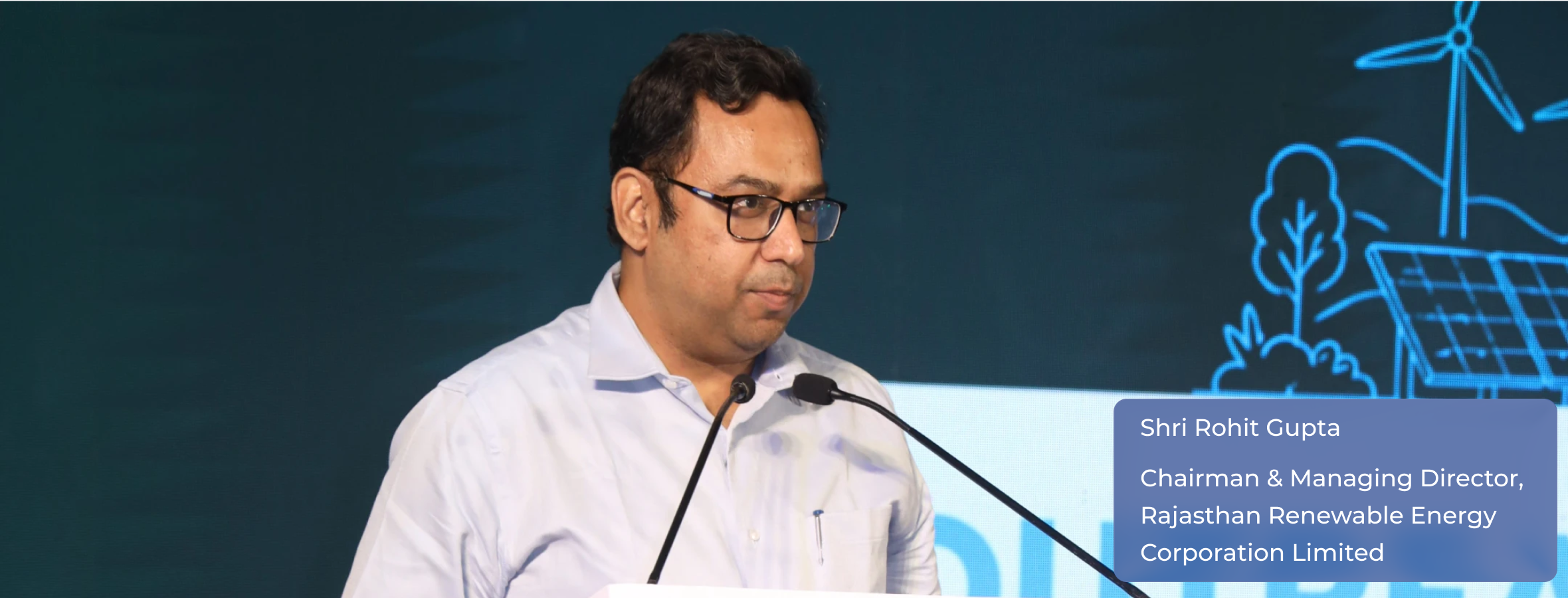
Shri Rohit Gupta,
Chairman & Managing Director,
Rajasthan Renewable Energy Corporation Limited
Rajasthan’s clean-energy story, Shri Rohit Gupta said, sits within an extraordinary national acceleration: India has moved from roughly 36 GW of renewable capacity in 2014 to around 300 GW in a decade, becoming the world’s third-largest renewable-energy market after China and the United States. He credited this growth substantially to private-sector participation and enabling initiatives from MNRE.
Gupta pointed to the pace of recent expansion—around 56 GW of non-fossil capacity added in the previous year alone—and then turned to the changing shape of projects. The next phase, he said, is moving away from standalone solar or wind towards solar-plus-wind-plus-storage, with battery storage becoming increasingly important. Rajasthan’s new Pugal solar park, he noted, is being developed with storage closely integrated into the project architecture.
His emphasis was instead on the challenges that accompany scale. Grid integration and curtailment become more difficult as renewable penetration rises; storage is one answer, but modern load-dispatch systems, stronger forecasting of demand and generation, and better grid management are equally important. Gupta described digitisation and AI as an emerging fifth pillar alongside solar, wind, hydro and biomass.
He also raised a less discussed issue: what happens to solar, wind and battery assets at the end of their lifecycle. Recycling, he argued, must be built into the transition so that clean-energy projects do not create a future environmental burden. At the same time, this challenge can become an investment opportunity in the circular economy.
On the demand side, Gupta said the next growth engine is likely to come increasingly from the commercial and industrial segment rather than only state distribution utilities. That makes regulatory and policy certainty important for keeping C&I demand robust and sustaining private investment.
For Gupta, the convergence of BRE Summit 2026, the 9th International Solar Alliance Assembly and the International Conference on Green Hydrogen reflects how the sector itself is widening—from generation into storage, digitalisation, circularity and industrial decarbonisation. He framed the Jaipur Roadshow not as a celebration of past success, but as an invitation to convert that success into the next phase of growth.