

11 October 2026


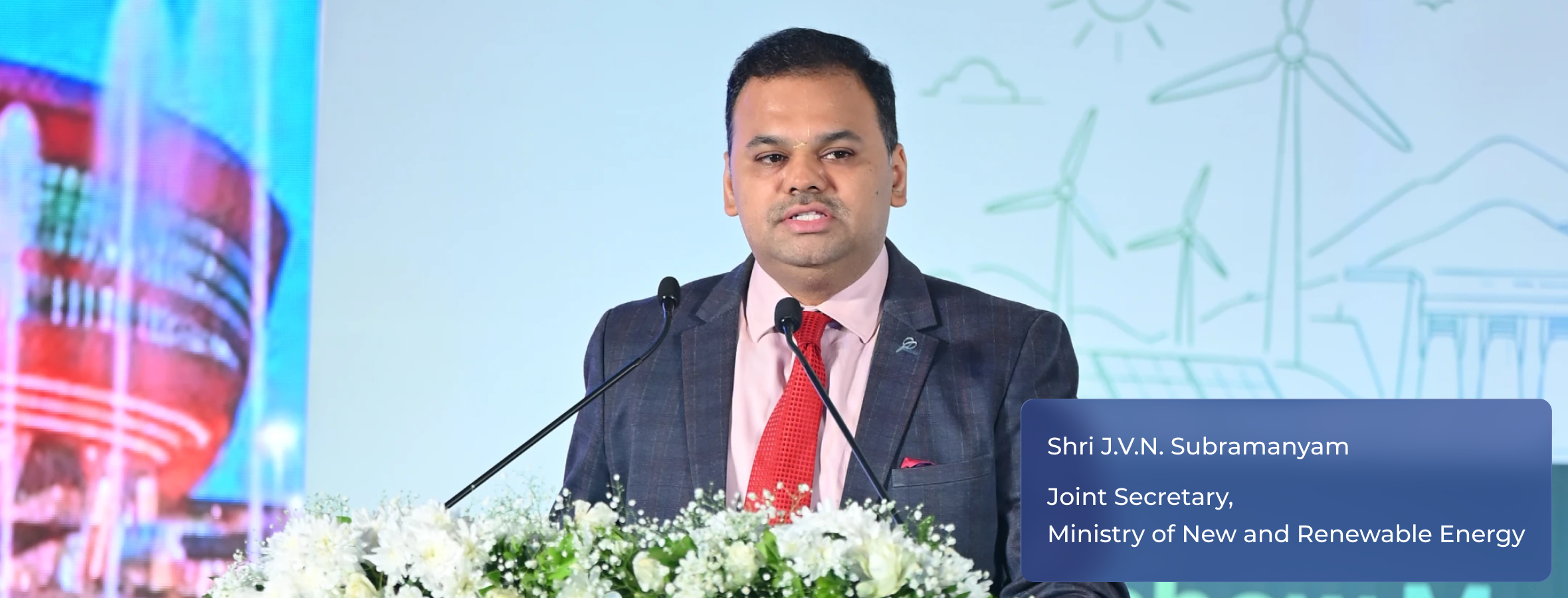
Shri J.V.N. Subramanyam
Joint Secretary, Ministry of New and Renewable Energy
Shri J.V.N. Subramanyam described renewable energy as a sector in which private enterprise has done most of the building while governments have created the policy ecosystem and the “highway” for business to grow.
That public-private model, he argued, explains much of India's acceleration and also provides the logic for BRESE 2026.
He placed India among the world's leading renewable markets: third overall, third in solar and fourth in wind, with solar having expanded by about 53 times since 2014 and wind by about 2.7 times.
The 500 GW non-fossil target, he explained, broadly comprises about 485 GW from renewable sources and another 15 GW from nuclear power.
He then brought the argument closer to Maharashtra. The state had crossed roughly 33 GW of renewable capacity, accounting for close to 12% of India's total, while Maharashtra also contributed to the country's emerging manufacturing base.
Subramanyam cited about 6% of India's solar-module manufacturing and around 10% of cell manufacturing as coming from Maharashtra. He also highlighted the state's energy-storage policy, industrial policy, green-hydrogen policy, pumped-storage framework and Mukhyamantri Saur Krushi Vahini programme.
On deployment, he pointed to Maharashtra's scale under PM Surya Ghar and PM-KUSUM: roughly 22% of national rooftop installations and nearly half of the country's solar pumps, including the 46,000-pump single-month Guinness record.
His larger point was that Maharashtra has already achieved scale; the next task is to convert that scale into accelerated manufacturing, capital formation and deployment.
BRESE 2026 was presented as the bridge: global delegations, state and country pavilions, investors, innovators, policy sessions, business matchmaking and bankable project pipelines under one platform.
He specifically urged Maharashtra to participate as a partner state, present investible projects, bring a clean-energy delegation and use the Summit to showcase the state's strengths to national and international audiences.
The private-sector story and the Maharashtra story therefore meet at the same point: scale now has to translate into business.
Subramanyam urged industry to use the Summit website and app, register early and begin building connections even before the event opens.
India has already demonstrated that renewable energy can expand rapidly.
The next test is whether policy, state capability and private enterprise can convert that momentum into investible growth at an even larger scale.