

10 October 2026


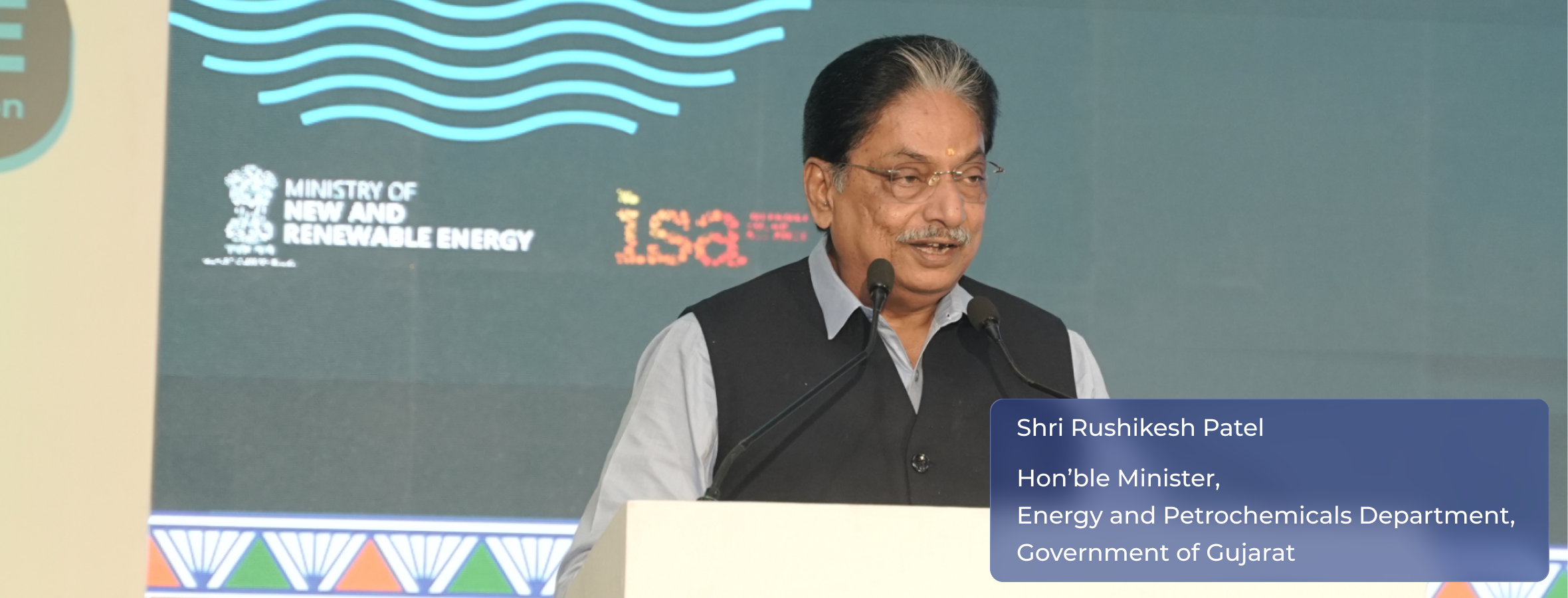
Shri Rushikesh Patel
Hon’ble Minister, Energy and Petrochemicals Department, Government of Gujarat
Renewable energy is often discussed through capacity targets, investments and technology.
Shri Rushikesh Patel, Hon’ble Minister, Energy and Petrochemicals Department, Government of Gujarat, brought another dimension to the Ahmedabad Roadshow: responsibility.
Patel connected Gujarat’s clean-energy journey directly with environmental degradation, rising temperatures and the obligation to ensure that future generations do not inherit the consequences of decisions being made today.
The urgency, in his argument, is no longer theoretical. The effects of environmental damage are already being experienced, making the transition towards cleaner energy a responsibility requiring participation from government, industry and citizens alike.
That urgency is backed by considerable existing scale.
Patel noted Gujarat’s approximately 52 GW of installed renewable-energy capacity, placing the state among India’s largest clean-energy markets.
But his speech also looked backwards.
Reflecting on Gujarat’s early renewable-energy initiatives, including the Charanka Solar Park, Patel recalled how decisive intervention and early adoption helped build the foundation for what has since become a much larger renewable-energy ecosystem.
The significance of Charanka lies not simply in the project itself. It represents a period when large-scale solar required considerable policy conviction, long before solar became commercially mainstream.
Patel also situated this journey within a broader Indian tradition of harnessing nature—from water to wind and, increasingly, sunlight. The current transition, however, is taking place at unprecedented speed and scale.
His emphasis was therefore on acceleration.
The destination is visible. The technologies increasingly exist. Policy momentum has been established. The question now is whether India and its states can move faster and achieve clean-energy ambitions ahead of schedule.
For Gujarat, that means expanding beyond its established solar and wind leadership into new areas including storage, green hydrogen and emerging clean-energy technologies.
But Patel’s message from Ahmedabad ultimately went beyond technology.
The energy transition will be judged not only by how many gigawatts are commissioned.
It will also be judged by the kind of environment one generation leaves behind for the next.