

10 October 2026


India’s renewable-energy transition is no longer only an environmental imperative. Shri K.J. George framed it as a driver of economic growth, industrial development, technological innovation, employment and energy security.
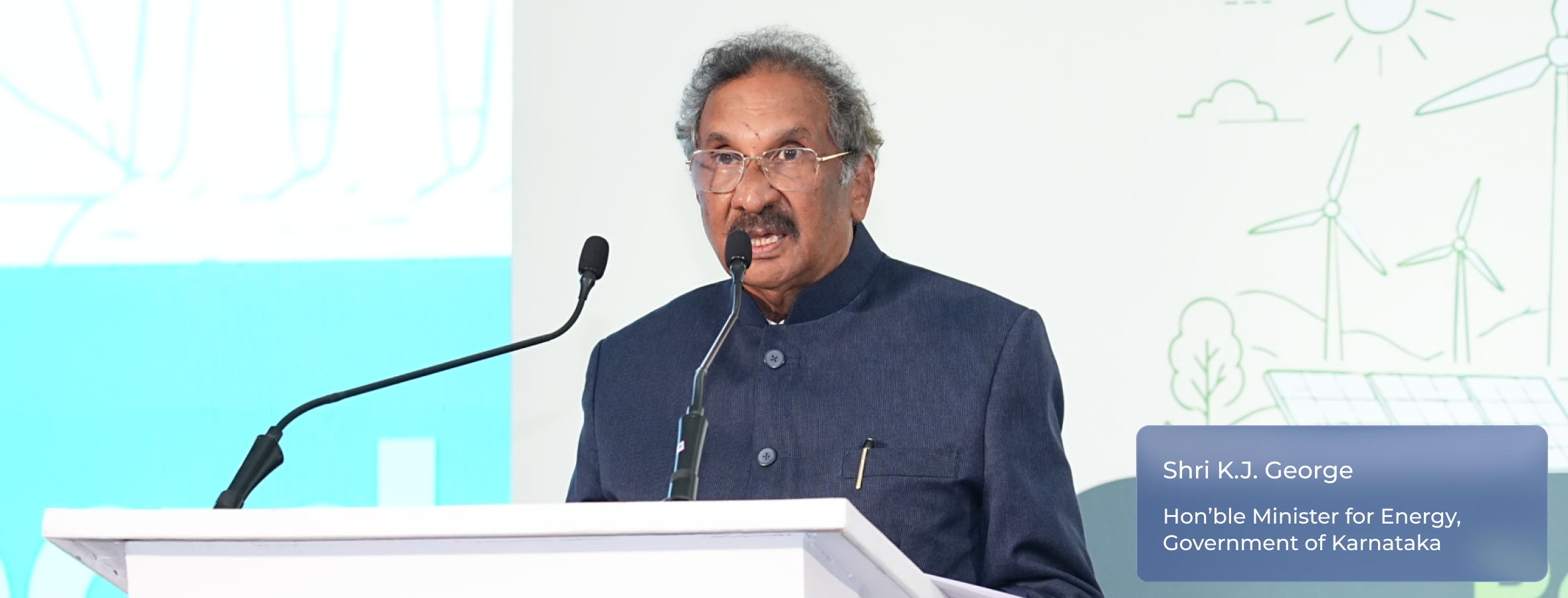
Shri K.J. George
Hon’ble Minister for Energy, Government of Karnataka
India’s renewable-energy transition is no longer only an environmental imperative. Shri K.J. George framed it as a driver of economic growth, industrial development, technological innovation, employment and energy security.
At the Bengaluru Roadshow for the Bharat Renewable Energy Summit & Expo 2026, George placed Karnataka within India’s larger transition: the country has crossed 300 GW of installed non-fossil-fuel capacity and is working towards 500 GW by 2030, with Karnataka positioning itself as an important partner in that national journey.
Karnataka already has nearly 27.3 GW of renewable-energy capacity, including more than 11.5 GW of solar and 8.5 GW of wind capacity.
Pavagada Solar Park illustrated the state’s approach to scale. George specifically highlighted how large renewable development there was combined with innovative land participation and local economic benefits. He recalled local landowners voluntarily offering around 10,000 acres and seeking further expansion, with another large tract then moving towards development.
But George’s strongest emphasis was on what comes after conventional solar and wind. He identified Battery Energy Storage Systems, pumped-storage projects, solar-wind hybrids, green hydrogen and derivatives, rooftop and distributed renewable energy, electric mobility, bioenergy, smart grids and digital-energy systems, renewable-energy manufacturing, and innovative clean-energy financing as the next opportunity set for Karnataka.
Energy storage, he stressed, will be especially critical as the share of variable renewable power increases.
The objective, in his words, is to move beyond simply adding renewable-energy capacity and build a system that is “flexible, reliable, resilient and future-ready.”
That shift also requires stronger collaboration between government, industry, academia, startups and financial institutions—particularly to develop commercially viable solutions in storage, green hydrogen, smart grids, renewable-energy forecasting and grid management.
Karnataka’s message to industry was therefore direct: the state is open for clean-energy investment, innovation and partnership. George invited investors and industry leaders to “Invest in Karnataka. Innovate in Karnataka. Partner with Karnataka.”
The proposition from Bengaluru is no longer just about renewable-energy scale. It is about turning that scale into a clean-energy system that is reliable enough for the grid, broad enough for industry and technology, and resilient enough for the next phase of India’s transition.