

10 October 2026


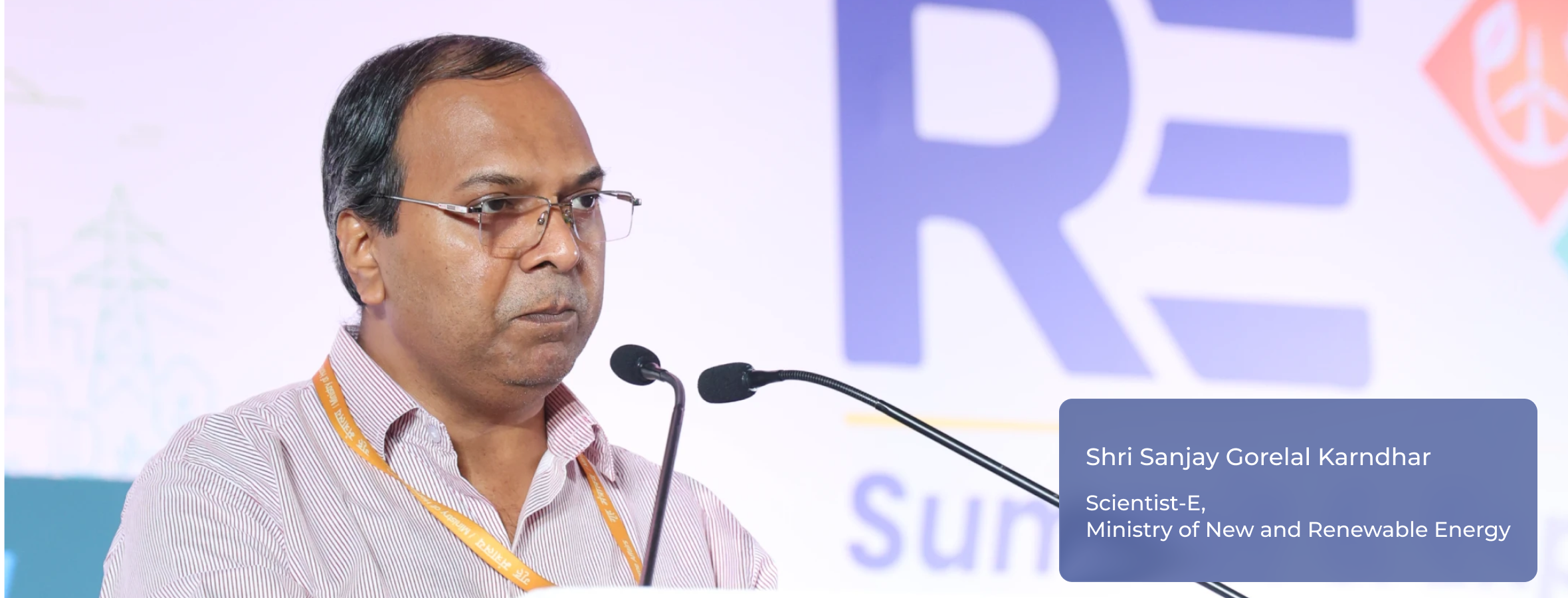
At the Hyderabad Roadshow for the Bharat Renewable Energy Summit & Expo 2026, Shri Sanjay Gorelal Karndhar, Scientist-E, Ministry of New and Renewable Energy, placed the scale of that transformation in perspective.
Shri Sanjay Gorelal Karndhar
Scientist-E, Ministry of New and Renewable Energy
India’s rise in renewable energy has been fast enough to change its position on the global energy map.
At the Hyderabad Roadshow for the Bharat Renewable Energy Summit & Expo 2026, Shri Sanjay Gorelal Karndhar, Scientist-E, Ministry of New and Renewable Energy, placed the scale of that transformation in perspective.
India, he noted, now ranks third globally in installed renewable-energy capacity, third in solar installations and fourth in wind energy.
The growth since 2014 has been equally striking.
Over approximately 12 years, India’s renewable-energy capacity has increased nearly four times. Solar capacity has expanded by around 55 times, while wind capacity has grown approximately 2.7 times.
The next national milestone is already defined: 500 GW of non-fossil-fuel installed capacity by 2030.
Karndhar explained that more than 485 GW of that capacity is expected to come from renewable-energy sources, with the balance expected from nuclear energy.
But capacity growth of this scale does not happen through targets alone.
Karndhar stressed that this growth has been enabled by private-sector investment, supported by policy and market frameworks created by the Central and state governments.
Karndhar identified three key pillars behind India’s renewable-energy expansion: policy, market creation and manufacturing impetus.
On the policy side, the 500 GW national target provides long-term direction. Renewable Consumption Obligations create demand, the ISTS waiver supports capacity addition across resource-rich regions, and the National Green Hydrogen Mission seeks to position India as a global hub for green hydrogen and its derivatives.
Market creation is equally central. Karndhar cited PM Surya Ghar: Muft Bijli Yojana, with an outlay of more than Rs 75,000 crore, and PM-KUSUM, with an outlay of more than Rs 34,000 crore. He also referred to recent approvals targeting around 5,000 MW of floating solar and around 1,500 MW of small hydropower, while the Green Energy Corridor strengthens renewable-energy transmission within states.
The manufacturing side is equally important.
On manufacturing, Karndhar highlighted Production Linked Incentive schemes for solar PV and batteries, the Approved List of Models and Manufacturers (ALMM) framework for solar PV and wind-turbine manufacturing, incentives for electrolyser manufacturing under the National Green Hydrogen Mission, and domestic-content requirements supporting Indian solar-cell and module production.
For Hyderabad, however, one number brought the regional opportunity into particularly sharp focus.
Telangana, Andhra Pradesh and Tamil Nadu together account for nearly 19% of India’s total renewable-power capacity.
He added that the three-state region has around 54 GW of renewable-energy capacity, represents roughly 19% of India's clean-energy footprint, hosts more than one-third of the country's solar-cell and wind-turbine manufacturing, and accounts for nearly 10% of PM Surya Ghar beneficiaries.
That makes the three-state region not merely a participant in India’s transition, but one of its important engines.
The invitation from Hyderabad was consequently straightforward: bring that capability to BRE Summit 2026.
India’s renewable journey has established scale. Its next phase will depend on whether policy, markets, manufacturing and state-level execution can continue scaling together.