

10 October 2026


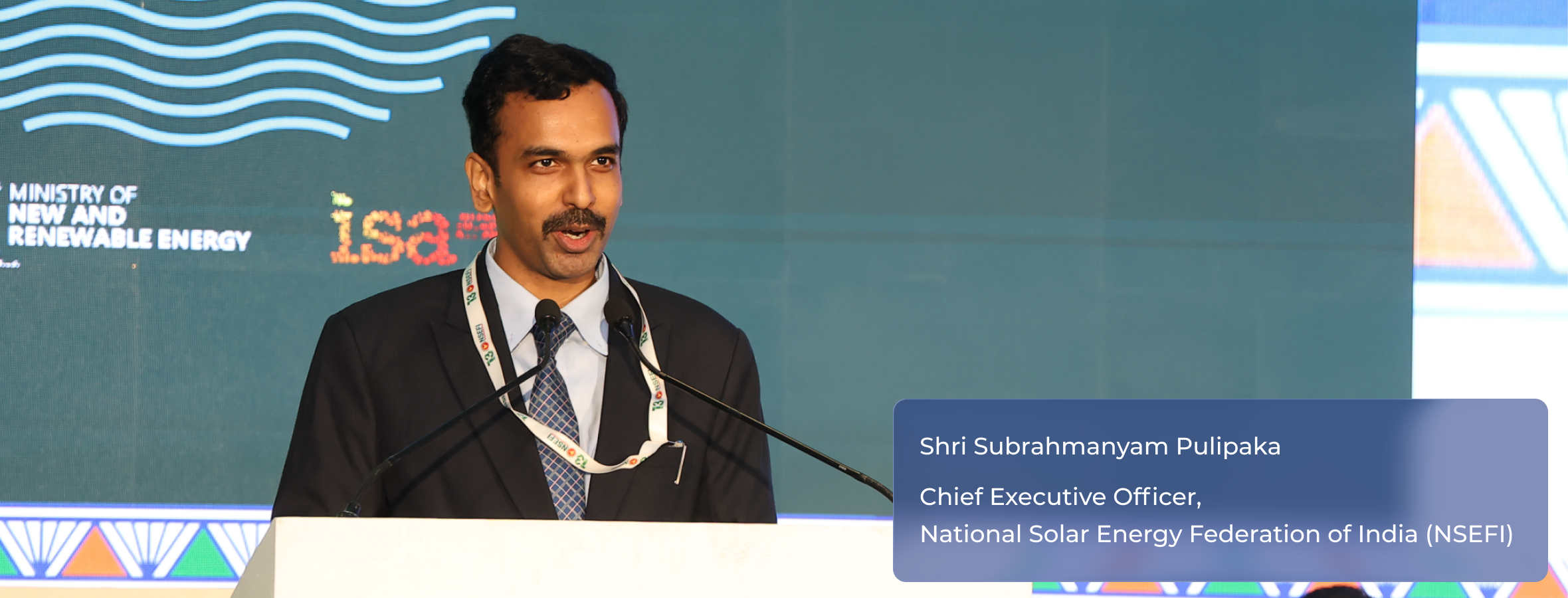
Shri Subrahmanyam Pulipaka
Chief Executive Officer, National Solar Energy Federation of India (NSEFI)
Sometimes the speed of a transition is more revealing than its total size.
At the Ahmedabad Roadshow, Shri Subrahmanyam Pulipaka, Chief Executive Officer, National Solar Energy Federation of India, used India’s solar milestones to illustrate just how dramatically that speed has changed.
India’s cumulative solar capacity stood at 168.04 GW as of 31 August 2026, according to the latest MNRE data cited in the review; in his speech, Pulipaka described the country as having more than 160 GW installed.
But the journey to that number did not happen at a constant pace.
According to Pulipaka, India took around 14 years to reach its first 50 GW of solar capacity. The second 50 GW required only three years.
The third 50 GW arrived in just 14 months.
And he expects the fourth 50 GW milestone to arrive in less than one year.
That acceleration is now spreading beyond utility-scale solar.
Under PM Surya Ghar: Muft Bijli Yojana, Pulipaka highlighted the speed of rooftop deployment, saying India was installing up to one lakh systems every week.
Agriculture represents another dimension. More than 2 million farmers, Pulipaka noted, are now connected with solar-powered agricultural systems and pumps through India’s solarisation programmes.
Industry is changing too.
Commercial and industrial renewable-energy procurement crossed the 10 GW mark for the first time last year, while more than 6 GW had already been added during the first five months of the current year, putting the market on course to surpass its previous performance.
Then comes manufacturing.
Pulipaka described a solar-module manufacturing base that has expanded from roughly 2 GW to around 200 GW. Solar-cell manufacturing has crossed approximately 30 GW, while further investments are emerging across wafers, ingots and polysilicon.
He described India as the world’s second-largest solar manufacturing base.
The next ingredient is storage.
For Pulipaka, India’s renewable success is not the result of one programme or technology. It comes from multiple pieces—utility-scale solar, rooftop deployment, agricultural solarisation, industrial demand, manufacturing and now energy storage, being developed as parts of the same transition.
India had the ingredients.
It has spent the last decade putting the recipe together.
The next opportunity is to demonstrate that recipe to the world.