

11 October 2026


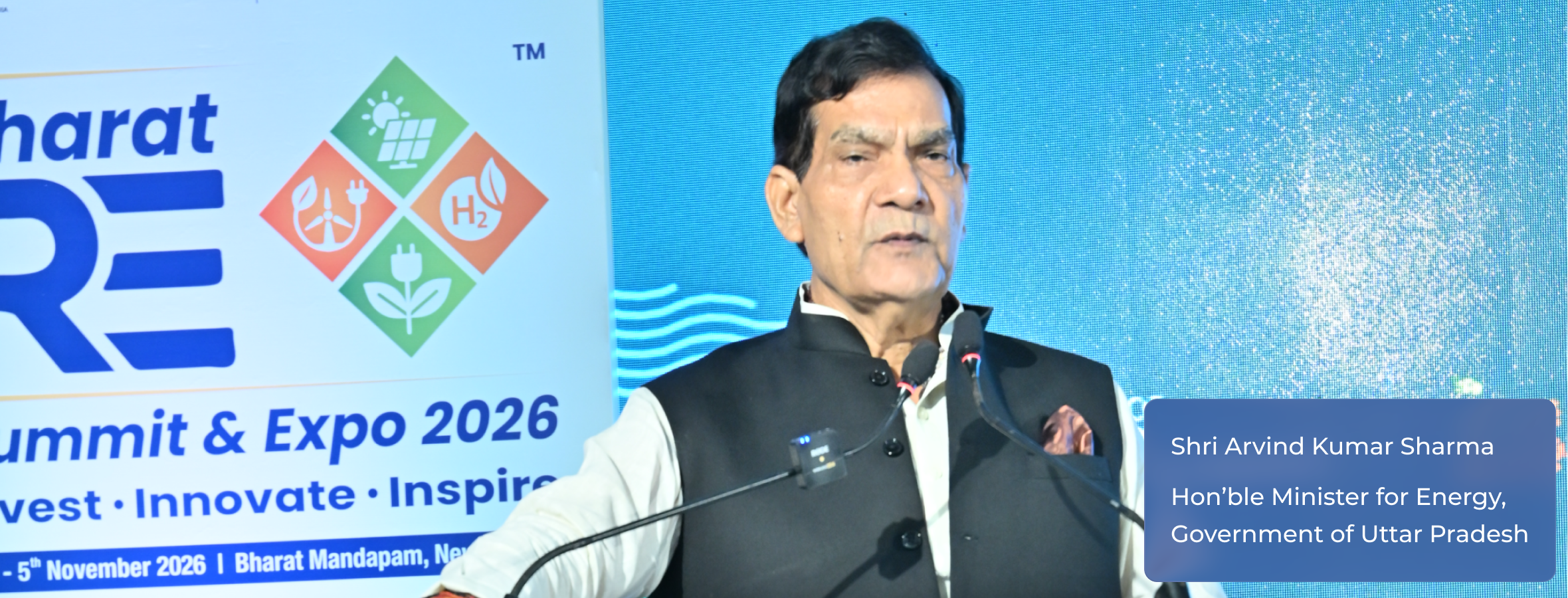
Shri Arvind Kumar Sharma
Hon’ble Minister for Energy, Government of Uttar Pradesh
Shri Arvind Kumar Sharma placed Uttar Pradesh’s renewable-energy opportunity inside India’s larger transition from more than 300 GW of non-fossil capacity towards the 500 GW ambition for 2030 and the Net Zero goal for 2070.
But his address was equally about the economic opportunity being created around that transition. Referring to PM Surya Ghar in Uttar Pradesh, he said around 8,000 vendors were already engaged in the programme, supporting roughly 90,000 to one lakh jobs, while rooftop installations had crossed around eight lakh homes.
For Sharma, this was evidence of what he repeatedly described as a parallel energy market and a parallel energy industry emerging alongside the conventional power system—one capable of creating businesses, employment and new entrepreneurs.
He invited industry to look across the full opportunity set in Uttar Pradesh: utility-scale solar, rooftop solar, solarisation of irrigation pumps and feeders, compressed biogas, bio-coal and green hydrogen.
On green hydrogen, he referred to recent interest from a Japanese industry delegation and said one or two companies had already begun pilot-scale production activity, including a project in Sitapur.
He also highlighted UPNEDA’s role in expanding the ecosystem—from utility-scale and rooftop solar to vendor development and the training of thousands of young people as Surya Mitras for employment in the sector.
His pitch to industry was direct: set up enterprises in Uttar Pradesh, use the state’s renewable-energy programmes as a business opportunity, and participate in the national Summit in New Delhi.
Sharma’s larger argument was therefore not only that renewable energy can decarbonise India’s power system, but that it can turn young people from job seekers into job creators while opening an entirely new industrial market.