

10 October 2026


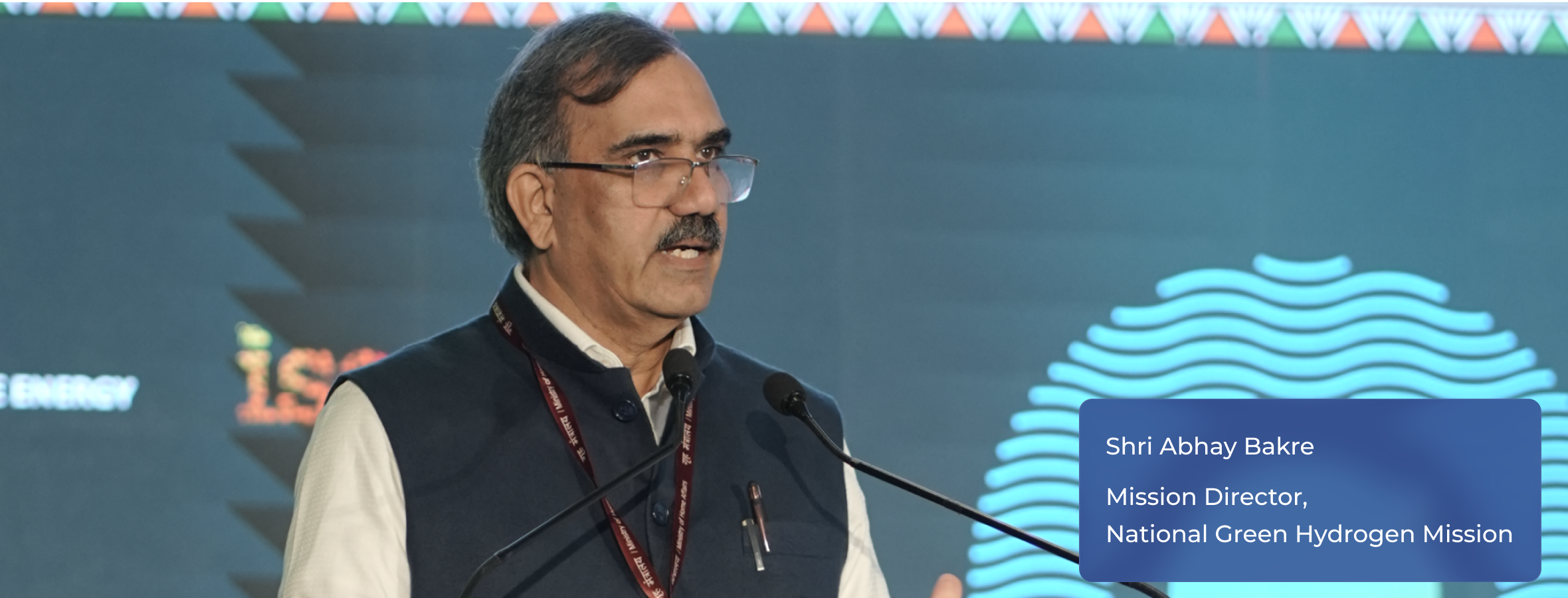
Shri Abhay Bakre
Mission Director, National Green Hydrogen Mission
India’s next renewable-energy chapter will not be shaped by solar and wind alone. Green hydrogen is emerging as the link between renewable power, manufacturing, industrial demand and new export markets.
That was one of the key themes in the address by Shri Abhay Bakre, Mission Director, National Green Hydrogen Mission, at the Ahmedabad Roadshow for BRE Summit 2026.
Bakre placed green hydrogen within the wider acceleration of India’s renewable-energy transition. Since RE-INVEST 2024, he noted, India has added more than 100 GW of renewable-energy capacity in just two years, taking the conversation beyond investment commitments towards the technologies and industries that must define the next two decades.
In that roadmap, green hydrogen is a major next step because its production will itself require additional renewable power, creating fresh demand for solar and wind while opening a new industrial value chain.
He also pointed to the manufacturing opportunity. Gujarat already has significant solar and wind manufacturing capacity, and the next phase includes electrolyser manufacturing and deeper domestic capability across clean-energy components.
Gujarat is particularly important to this transition because it can combine renewable-energy production, industrial consumption and access to ports within the same state.
Bakre highlighted Gujarat’s Green Hydrogen Policy, which is targeting approximately 3 million tonnes of green-hydrogen capacity by 2035.
He also connected that production potential with export infrastructure, noting the role that ports such as Mundra and Kandla could play in moving green hydrogen and its derivatives towards international markets, including Europe.
This combination of renewable resource, manufacturing, demand centres and ports gives Gujarat a distinctive position in the emerging hydrogen economy.
Bakre then placed that opportunity within the larger BRE Summit platform. He said participation was expected from international partners including Denmark, the European Union, the United Kingdom, Germany and the Netherlands, creating opportunities for direct engagement with investors, technology providers and governments.
For Gujarat, the relevance is practical: the state can present its policies, incentives, projects and manufacturing opportunities directly to global stakeholders while exploring technology and investment partnerships.
The Summit agenda, as Bakre outlined it, will extend across storage, distributed renewable energy, global solar markets, advanced manufacturing, batteries, hydrogen, electrolysers, AI and digitalisation.
That breadth matters because green hydrogen cannot scale in isolation. It depends on abundant renewable electricity, manufacturing capacity, financing, infrastructure, technology and markets developing together.
Bakre’s message therefore moved beyond a single technology. The National Green Hydrogen Mission sits within a broader industrial transition in which renewable energy becomes the feedstock for new manufacturing and export opportunities.
BRE Summit 2026 is intended to bring those pieces onto one platform: policy, technology, investment, manufacturing and international collaboration.
For Gujarat, which is already targeting more than 100 GW of renewable capacity by 2030, green hydrogen adds another layer to that ambition.
The next test is not simply how much clean power India can generate, but how effectively it can convert that power into new industries, new technologies and globally competitive clean-energy products.