

10 October 2026


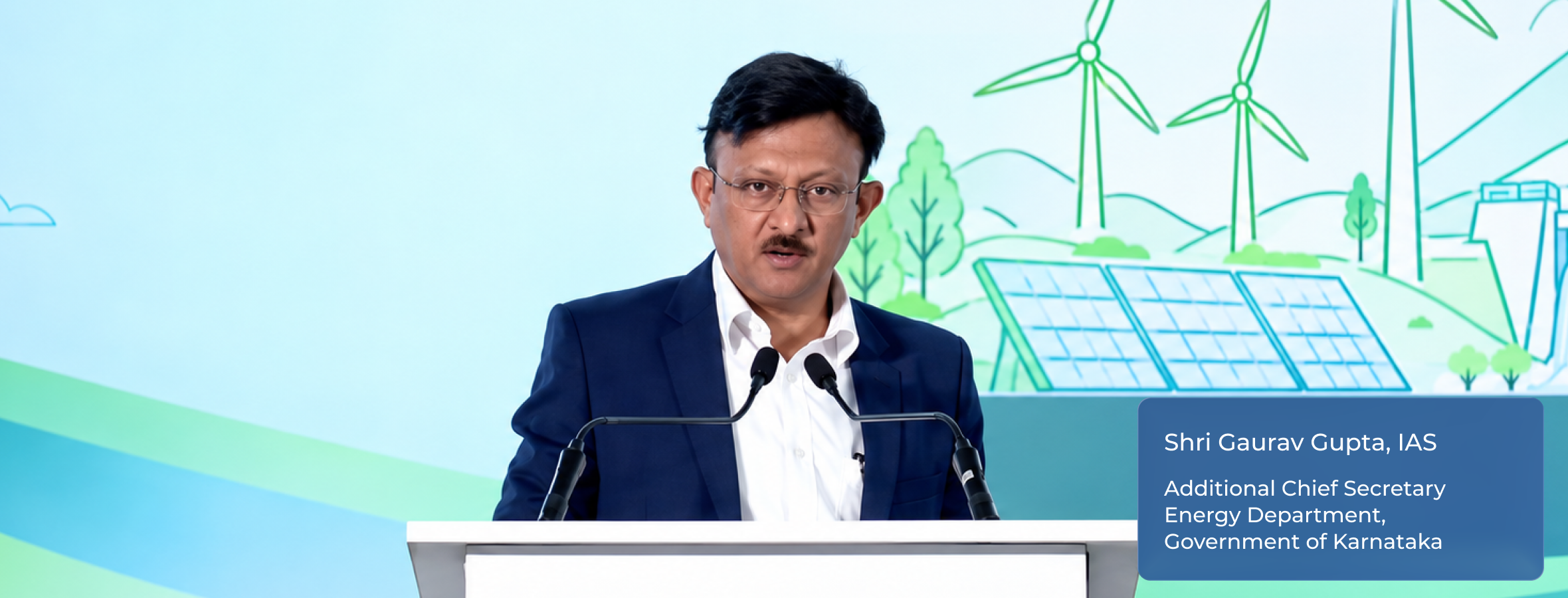
Karnataka’s renewable-energy story, Shri Gaurav Gupta argued, is no longer simply about generation. It is increasingly about how policy, transmission, land, manufacturing, employment and electricity demand are managed together.
Shri Gaurav Gupta, IAS
Additional Chief Secretary, Energy Department, Government of Karnataka
Karnataka’s renewable-energy story, Shri Gaurav Gupta argued, is no longer simply about generation. It is increasingly about how policy, transmission, land, manufacturing, employment and electricity demand are managed together.
Speaking at the Bengaluru Roadshow for the Bharat Renewable Energy Summit & Expo 2026, Gupta traced Karnataka’s renewable policy journey back nearly 15 years and described a deliberately diverse energy portfolio that has included solar, wind, waste-to-energy, biomass and other sources.
Agriculture remains a critical part of that system. Karnataka is working with MNRE on PM-KUSUM Components B and C, while irrigation pump sets account for roughly 40–50% of the state’s power consumption—making farm-energy transition a major part of the clean-energy challenge.
Gupta also linked renewable energy directly to manufacturing, employment and skilling. In his account, clean power is already creating value beyond electricity generation through new industrial activity and jobs in the state.
Transmission is equally central. Gupta said about 26 GW of power is being evacuated from Karnataka through the Central Transmission Utility network, with the requirement expected to rise further; the state is also adding roughly 4–5 GW of renewable energy annually across central and state transmission systems.
One of the most practical reforms he highlighted concerned land leasing. Following industry feedback, Karnataka simplified legislation, rules and online processes so that a leasing exercise that could earlier take four to six months can, in suitable cases, be completed in a day.
That administrative responsiveness is being matched by continued expansion of both state and central transmission infrastructure, reflecting the state’s effort to remove execution bottlenecks rather than treat policy announcements as the end point.
Electricity demand is also changing quickly. Gupta contrasted the earlier norm of roughly 3–5% consumption growth with a current national growth range closer to 7–10%. In Karnataka, he cited an even sharper year-on-year rise in daily consumption, while cautioning that poor monsoon conditions may have contributed to that spike.
For Gupta, the opportunity is therefore operational as much as strategic: make land easier to access, strengthen transmission, respond to industry, connect renewable energy with manufacturing and employment, and prepare for a faster-growing electricity market.
Karnataka’s clean-energy advantage will ultimately be measured not only by how much renewable capacity it announces, but by how effectively it converts policy into projects, infrastructure and economic growth.