

11 October 2026


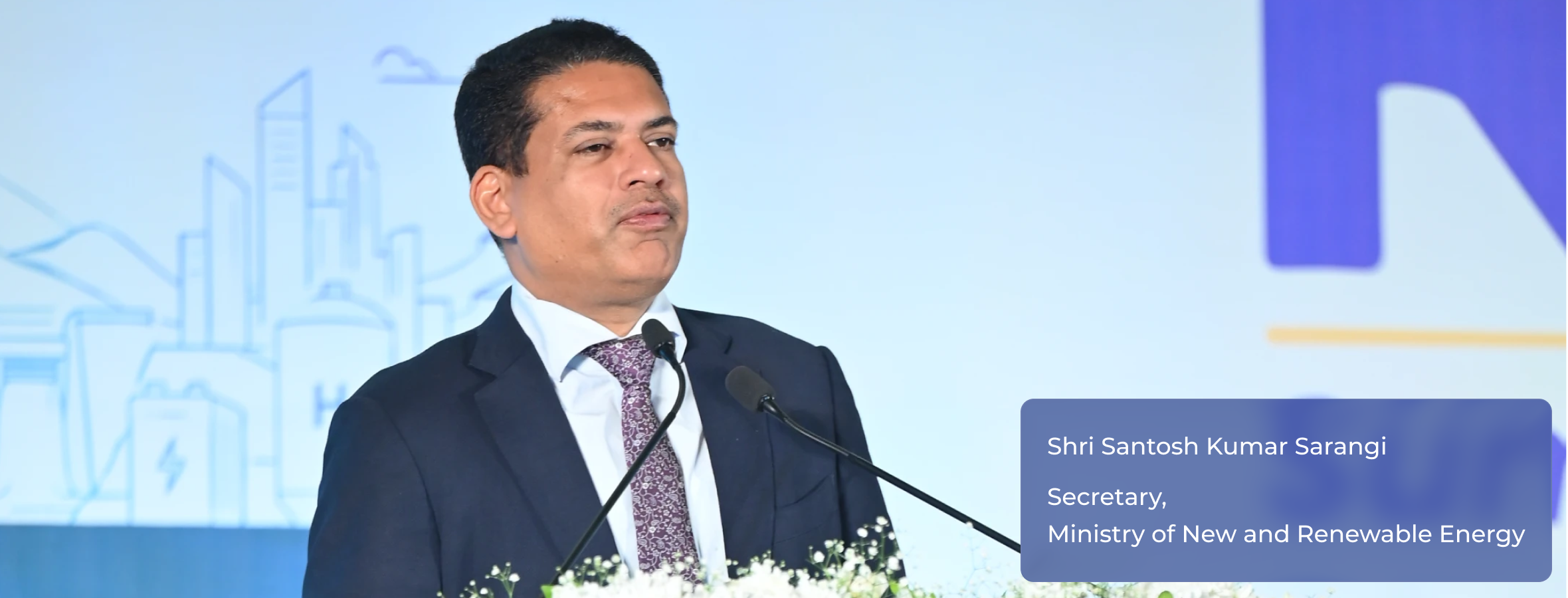
Shri Santosh Kumar Sarangi
Secretary, Ministry of New and Renewable Energy
“Policy may be initiated in Delhi, but financial closure happens in Mumbai.” That observation became the organising thought of Shri Santosh Kumar Sarangi's address.
For Sarangi, Mumbai matters because India's renewable-energy growth has reached a stage where policy ambition must increasingly be matched by finance, manufacturing depth and a grid capable of absorbing far more clean power.
He traced the growth story to three enablers: policy certainty, deliberate market creation and a sustained manufacturing push.
The 500 GW non-fossil target, Renewable Purchase and Consumption Obligations and the ISTS waiver created long-term visibility. Market-creation measures then expanded demand through solar parks, CPSU deployment, PM Surya Ghar, PM-KUSUM and the newly announced PM Surya Sarovar programme for floating solar.
Manufacturing is the third foundation. Sarangi cited more than 214 GW of module manufacturing, about 33 GW of cell manufacturing and roughly 24 GW of wind-turbine manufacturing capacity, supported by instruments such as PLI and ALMM.
But he explicitly cautioned that the next stage is “neither inevitable nor automatic”. Higher renewable penetration brings grid-integration and transmission challenges, while the system must simultaneously protect energy security, reliability and affordability.
As one example, he referred to a recent round-the-clock renewable tender discovered at about ₹5.25 per unit, arguing that developers and manufacturers are reaching the maturity needed to provide firmer green power at increasingly competitive prices.
Digital integration, AI and local distribution management add another layer of complexity as renewable penetration grows.
Capital is therefore central. Sarangi estimated the requirement at roughly US$350 billion and specifically called on banks and institutions such as IREDA, PFC and REC to reinforce their commitment to sustainable infrastructure.
His expectation from BRESE 2026 was practical: manufacturers should demonstrate world-class capability, vendors should strengthen supply pipelines, states should pitch investor-friendly policies and financiers should help convert ambition into projects.
The Summit, in his framing, is a one-stop platform where policy, manufacturing, finance and implementation can meet.
That is the proof India now has to present to the world: the renewable-energy story is not temporary or transitional.
It is here to stay, continue and grow.