

11 October 2026


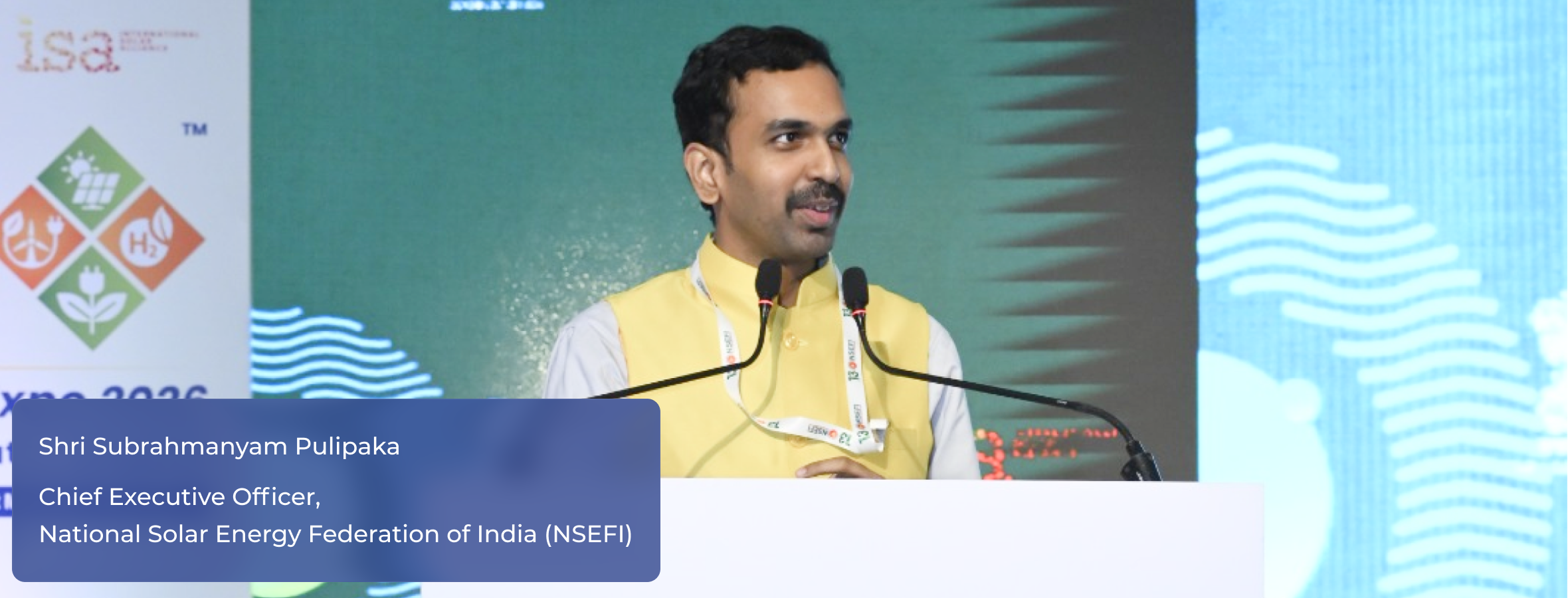
Shri Subrahmanyam Pulipaka
Chief Executive Officer, National Solar Energy Federation of India (NSEFI)
Shri Subrahmanyam Pulipaka used one number to establish the scale of India’s solar transformation: installed solar capacity has moved from less than 2 GW around fourteen years ago to close to 168 GW today.
He described India as the world’s third-largest solar market and said Uttar Pradesh is the country’s fourth-largest base for solar manufacturing.
Pulipaka then made the Uttar Pradesh story more specific. Referring to NSEFI’s internal assessment of states, he said Uttar Pradesh had ranked No. 1 for the last two years in three domains: C&I attractiveness, PM-KUSUM and rooftop solar.
He argued that this was a major shift for a state that, less than six years earlier, did not feature prominently in many national renewable-energy discussions.
Manufacturing was another part of his outlook. He said India was approaching 50 GW of solar-cell manufacturing and expected greater ingot and wafer manufacturing, strengthening the upstream domestic solar value chain.
On PM-KUSUM, Pulipaka cited approximately 1.2–1.3 million pumps under Component B and another 1.4–1.5 million pumps or feeder-linked systems solarised through the wider programme. He linked this to savings running into thousands of crores of rupees in avoided diesel expenditure for irrigation.
His larger point was participatory: every household installing rooftop solar, every farmer installing a solar pump and every consumer using clean electricity becomes, in his words, a clean-energy ambassador.
For Uttar Pradesh, he saw an integrated opportunity spanning not only solar but also wind, bioenergy, green hydrogen and the wider renewable-energy value chain.
The transformation from less than 2 GW to 168 GW was therefore presented not only as an Indian success story, but as proof of concept for other countries navigating their own energy transitions.