

10 October 2026


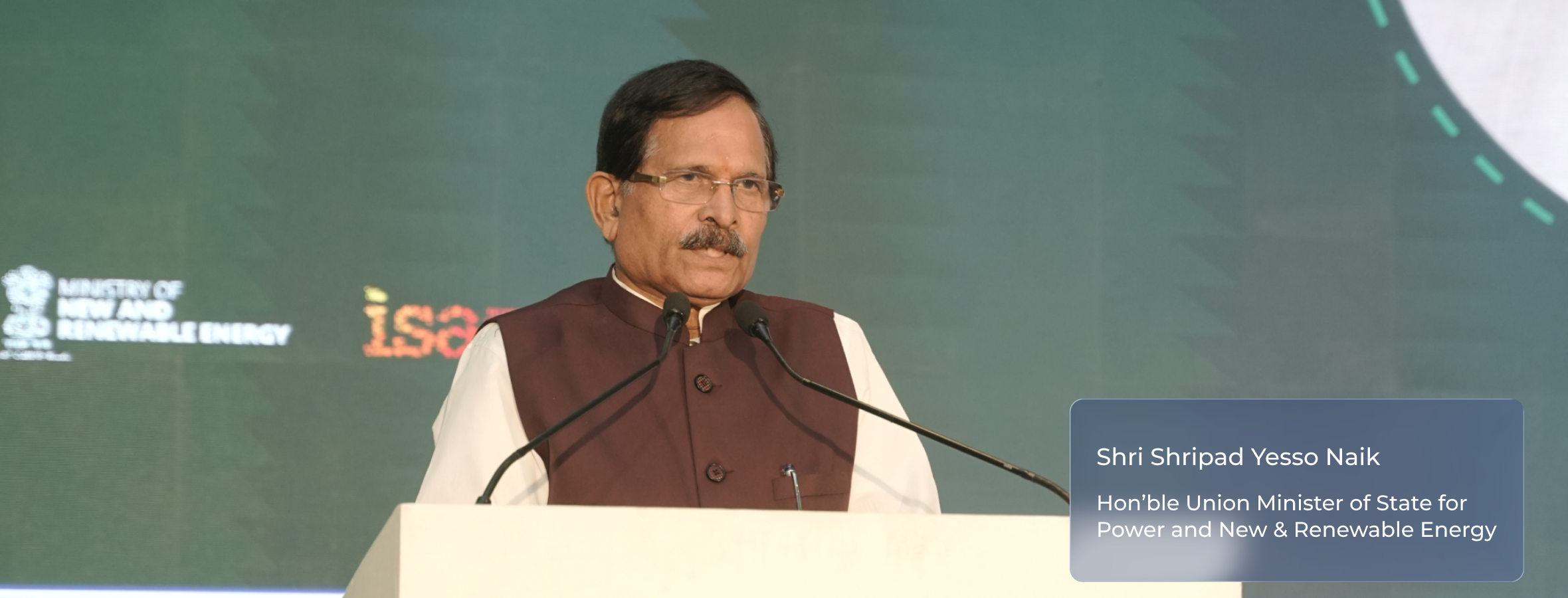
Shri Shripad Yesso Naik
Hon’ble Union Minister of State for Power and New & Renewable Energy
Gujarat’s contribution to India’s renewable-energy journey cannot be understood simply through installed megawatts. It is also a story of seeing economic opportunity where others once saw geographical constraints.
That was the central message of Shri Shripad Yesso Naik, Hon’ble Union Minister of State for Power and New & Renewable Energy, at the Ahmedabad Roadshow for the Bharat Renewable Energy Summit & Expo 2026.
Naik traced Gujarat’s early push into solar and wind energy to a period when renewable energy was still far from mainstream. The state’s approach, he noted, was to view clean energy not merely as another source of electricity but as an instrument of economic development, energy security and technological progress.
That early vision has now moved to an entirely different scale.
Gujarat has set a target of 105 GW of renewable-energy capacity by 2030. Naik emphasised that the significance of the target lies not merely in the number but in the state’s approach: desert landscapes have become locations for solar development, wind has evolved into an industrial opportunity, and the next chapter is extending into green hydrogen, energy storage, offshore wind and clean-energy manufacturing.
The official Ahmedabad Roadshow profile places that ambition against an already substantial base. Gujarat has around 52 GW of installed renewable-energy capacity, accounting for approximately 17.82% of India’s renewable-energy base. The state ranks first nationally in wind installations and second in solar capacity.
For Naik, however, the next phase requires more than capacity addition.
Investment has to connect with projects. Technology has to connect with markets. Manufacturing has to scale alongside deployment. And states must increasingly present their projects and policy frameworks directly to global investors and technology providers.
That is the role he envisaged for BRE Summit 2026.
Naik invited Gujarat to bring its projects, technologies, investment opportunities and ambitions to the Summit in New Delhi and use the platform to help shape India’s next clean-energy chapter.
The message from Ahmedabad was therefore larger than Gujarat’s 105 GW target.
What began as a decision to harness sunshine and wind is now becoming an industrial strategy—linking energy, technology, manufacturing and investment.
And Gujarat intends to remain at the centre of it.