

11 October 2026


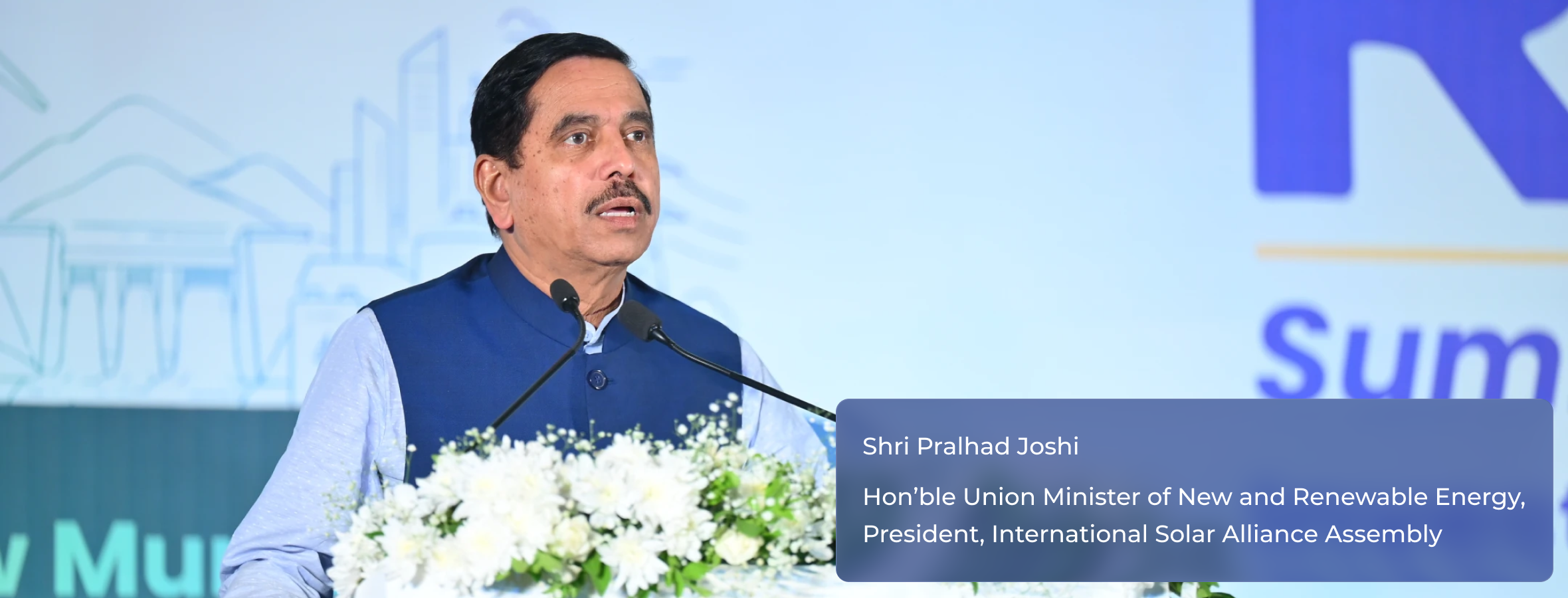
Shri Pralhad Joshi
Hon’ble Union Minister of New and Renewable Energy | President, International Solar Alliance Assembly
India's clean-energy transition has crossed the 300 GW non-fossil milestone. At Mumbai, Shri Pralhad Joshi framed the next phase not merely as capacity addition, but as an opportunity to attract capital, deepen manufacturing and build new energy industries.
Addressing the Mumbai Roadshow for the Bharat Renewable Energy Summit & Expo 2026, the Union Minister placed India's progress in the context of both speed and global investor interest.
Joshi said India had moved from about 80 GW of non-fossil capacity twelve years ago to roughly 302 GW. Solar, he noted, had expanded from 2.8 GW to about 165 GW, while wind had risen from roughly 21–22 GW to around 59 GW.
He also highlighted the pace of the current build-out: about 17 GW of capacity had been added in the first four months of the financial year, reinforcing his argument that India is moving at unprecedented scale.
For Mumbai, however, the important signal was investment. Joshi referred to approximately ₹6.4 lakh crore of domestic investment in the energy sector over the previous two years, saying investor interest in India had strengthened sharply.
The household transition is becoming equally visible. Joshi referred to around 50 lakh rooftop-solar beneficiaries under PM Surya Ghar and said about 19 lakh of them were receiving zero electricity bills.
Green hydrogen was another emerging frontier. He said the discovered cost had already reached around ₹279 per kg and that the effort was to bring it below ₹250 per kg, a threshold that could materially improve industrial competitiveness.
Joshi also positioned BRESE 2026 as a global convergence platform. He referred to the International Solar Alliance's 130+ member-country network and indicated that around 8–10 countries were expected to participate as partner countries, alongside international investors and industry partners.
His address therefore moved between three connected ideas: India has achieved scale; global capital is looking for credible Indian partners; and the next clean-energy opportunity will increasingly be built around manufacturing, reliable power and new-energy technologies.
For Maharashtra and Mumbai, that creates a natural role: connect finance with deployable projects, connect global investors with Indian partners, and use the Summit to convert interest into business relationships.
The message from India's financial capital was less about celebrating a number and more about what the 300-GW milestone now makes possible.
BRESE 2026 is intended to help turn that possibility into investment, partnerships