

10 October 2026


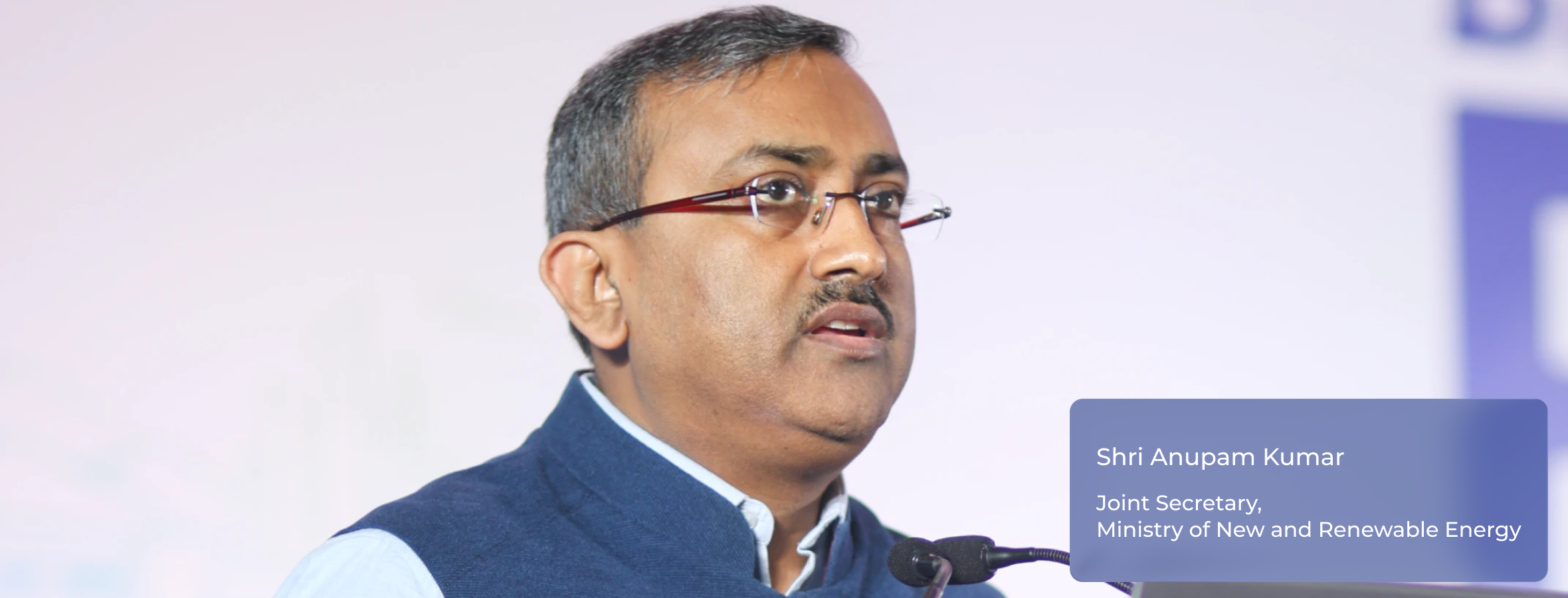
Shri Anupam Kumar
Joint Secretary, Ministry of New and Renewable Energy
India’s renewable-energy transition has reached a point where national targets alone are no longer enough.
The next phase has to be built in the states.
That was the central message of Shri Anupam Kumar, Joint Secretary, Ministry of New and Renewable Energy, at the Hyderabad Roadshow for Bharat Renewable Energy Summit & Expo 2026.
As of 31 July 2026, India had crossed 300 GW of installed non-fossil-fuel capacity. Solar alone had reached approximately 165 GW, while wind capacity had crossed 58 GW.
The next national objective is 500 GW of non-fossil-fuel-based installed electricity capacity by 2030.
But Kumar argued that the coming phase cannot be measured purely through additional generation capacity. The central question is whether India can deliver clean energy at the right time, in the right place, in the required quantity, with reliability and competitive prices.
India now needs an integrated clean-energy ecosystem covering transmission, energy storage, manufacturing, green hydrogen, flexible power, demand management and digital technologies.
The opportunity extends into solar manufacturing, power electronics, battery and other storage technologies, electrolysers, green hydrogen and its derivatives, grid technologies, AI-enabled forecasting, digital energy-management systems, electric mobility, bioenergy and advanced materials.
For Kumar, this makes the renewable-energy transition not simply an energy opportunity but an industrial opportunity, with a large engineering-services ecosystem developing around these technologies.
Telangana, Andhra Pradesh and Tamil Nadu are particularly well positioned within this transition.
Their strengths in technology, engineering, manufacturing, research and entrepreneurship mean they need not remain simply consumers of clean-energy technologies. Kumar urged them to become producers, innovators, investors and technology partners.
But government cannot build this transition alone.
Capital must come. Technology must come. Partnerships and research must follow.
Kumar used the previous RE-INVEST to illustrate what an effective national platform can achieve. The 2024 edition in Gandhinagar attracted more than 25,000 delegates and over 360 companies, facilitating 816 B2B meetings and 110 B2G meetings.
Most significantly, it secured approximately ₹32.45 lakh crore in investment commitments.
BRE Summit 2026 is intended to build upon that legacy.
Kumar described the idea as creating a place where policy meets capital, capital meets projects, technology meets markets, states meet investors, developers meet partners and ideas become implementation.
For Hyderabad, however, his strongest emphasis was on the role of the states.
Telangana, Andhra Pradesh and Tamil Nadu are not being invited merely to attend BRE Summit 2026. They are being invited to showcase themselves.
Kumar urged the three states to bring their renewable-energy roadmaps, investment opportunities, green-hydrogen plans, storage opportunities and industrial ambitions to New Delhi. He similarly called upon them to bring manufacturers, developers, startups, researchers and young innovators.
Because India’s renewable-energy targets may be national.
He sharpened the Summit's theme - "Invest. Innovate. Inspire." - with one additional word: "Implement." India, he argued, has reached a stage where ambition is no longer the constraint; execution is. The task is to move from commitments to projects, projects to assets, technology to demonstration at scale, imports to competitive manufacturing, and fragmented initiatives to integrated ecosystems.
But their implementation will ultimately happen on the ground, in its states.