

10 October 2026


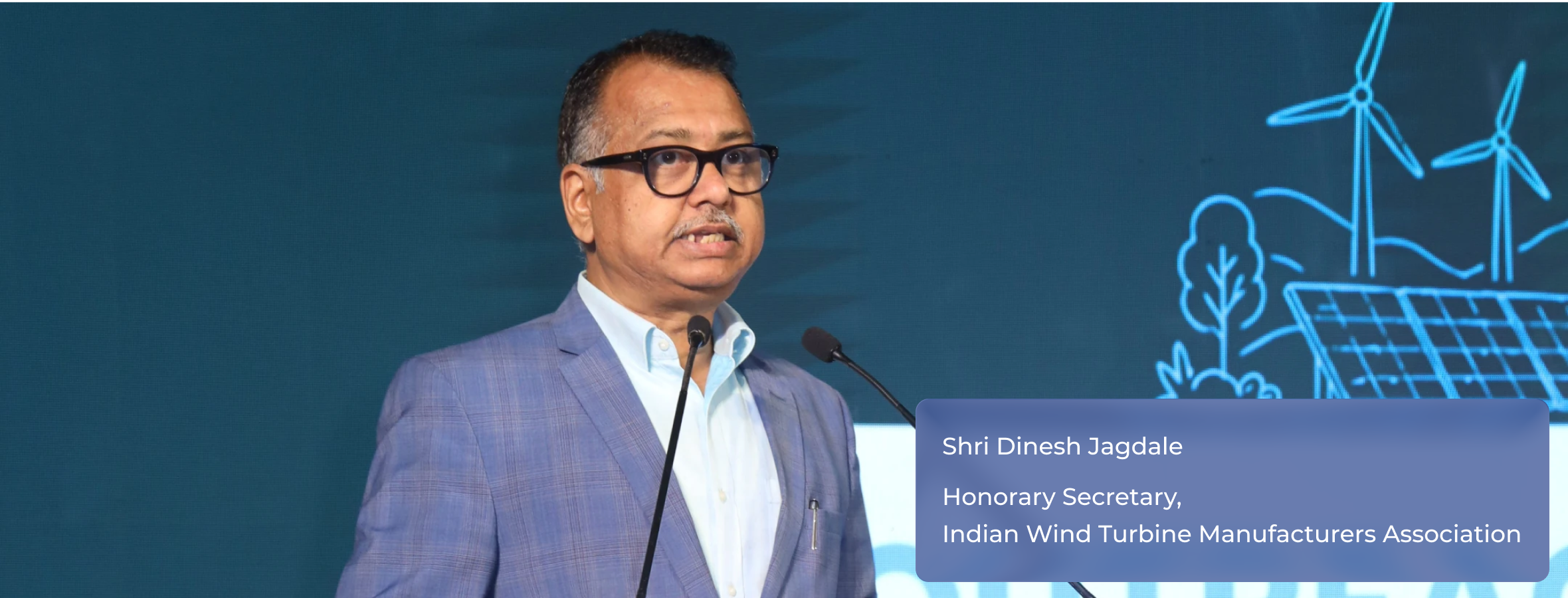
Shri Dinesh Jagdale,
Honorary Secretary,
Indian Wind Turbine Manufacturers Association
India has crossed 300 GW of non-fossil capacity, with more than half of the country’s installed electricity capacity now coming from clean and non-fossil sources. For Shri Dinesh Jagdale, that milestone establishes the scale already achieved—but also raises the bar for what comes next.
Jagdale cited national wind capacity of almost 58 GW and solar capacity of more than 170 GW. With the 500-GW target for 2030 ahead, he said the sector must now move towards combinations of resources capable of delivering firmer, round-the-clock green power rather than treating solar and wind in isolation.
The Jaipur setting carried its own historical relevance. Jagdale recalled that India’s modern wind-energy journey traces important roots to Jaisalmer, where some of the country’s early wind installations emerged in the late 1990s. Rajasthan therefore enters the next phase not only as a major solar state, but as a state with a long history across renewable technologies.
He positioned BRE Summit 2026 as a unified national platform bringing solar, wind, green hydrogen and energy storage under one roof, alongside the International Solar Alliance Assembly. The reason, he argued, is structural: developers need policy clarity, manufacturers need demand visibility, financial institutions need bankable frameworks and distribution companies need reliable, well-integrated green power.
The Summit is therefore intended to create structured dialogue among Central and State Governments, industry associations, financiers and technology providers. Jagdale’s argument was that the next phase of renewable growth has to be built on partnerships rather than fragmented effort.
That collaboration becomes more important as India moves towards 500 GW by 2030 and begins looking beyond it. Higher renewable penetration will demand not simply more generation, but stronger integration, financing, manufacturing and system reliability.
For the wind industry, the opportunity lies increasingly in how wind complements solar and storage to create a firmer renewable-energy profile. This is the transition from counting isolated megawatts to designing an energy mix that can serve demand more consistently.
BRE Summit 2026, scheduled for 2–5 November at Bharat Mandapam, New Delhi, is meant to bring these interdependent conversations onto one platform under the theme ‘Invest. Innovate. Inspire.’
Jagdale’s Jaipur address therefore linked India’s headline capacity achievement to the practical requirement of partnership: policy, capital, technology, manufacturing and grid needs must move together if clean power is to become both larger and firmer.