

10 October 2026


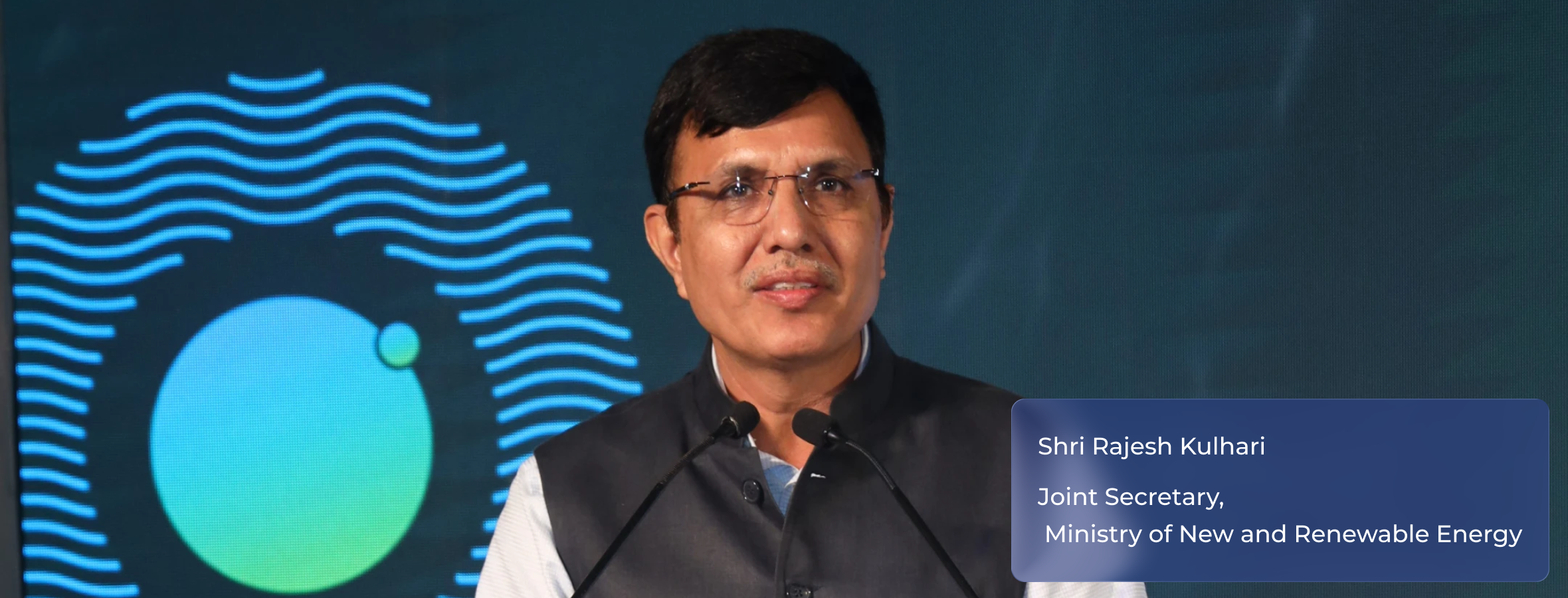
Shri Rajesh Kulhari,
Joint Secretary,
Ministry of New and Renewable Energy
India’s renewable-energy journey, Shri Rajesh Kulhari argued, has reached a stage where the question is no longer whether the sector can scale, but how quickly, efficiently and sustainably it can do so. India has already crossed 300 GW of renewable-energy capacity—about 60% of the 500 GW target for 2030—and renewable energy now represents roughly 54% of the country’s total installed power capacity of about 552 GW.
For Kulhari, Rajasthan is central to that next phase. He cited an assessed solar potential of approximately 829 GW and wind potential of around 284 GW at a 150-metre hub height. Rajasthan’s Integrated Clean Energy Policy 2024 targets 125 GW of renewable capacity by 2030, while the state has already crossed 50 GW of installed renewable capacity.
He also placed the state’s ambition in a wider systems context. The policy recognises hybridisation, storage, transmission infrastructure, distributed generation and manufacturing, while promoting solar and renewable-energy parks, rooftop solar, decentralised projects, renewable-powered EV charging and equipment manufacturing. Kulhari described this as the necessary shift from simply adding capacity to building the capability to manage renewable power at scale.
That capability, he said, must include storage, forecasting, scheduling, balancing and grid management because solar and wind are inherently variable. Rajasthan’s large resource and land base therefore creates not only a generation opportunity, but an integration opportunity: using clean electricity productively closer to demand centres and across emerging industries.
Green hydrogen was one such opportunity explicitly highlighted in his address. Kulhari said the National Green Hydrogen Mission seeks to develop India as a global hub for the production, use and export of green hydrogen and its derivatives, linking renewable electricity with difficult-to-decarbonise sectors such as fertilisers, refining, steel and shipping, while opening opportunities in manufacturing, technology development and exports.
He also stressed that the transition must reach households, farms, small enterprises and communities, citing PM Surya Ghar as an example of renewable energy becoming a story of household economics, employment and energy security. Government alone, he added, cannot deliver the required scale: developers, manufacturers, financial institutions, states, utilities and research institutions must work together.
BRE Summit 2026, to be held from 2–5 November at Bharat Mandapam, New Delhi, was therefore positioned by Kulhari as a platform for practical action: accelerating execution, integrating more renewable energy into the grid, scaling storage, deepening domestic manufacturing, developing green-hydrogen markets and mobilising capital. His closing invitation was direct—use the Summit to make Rajasthan an even stronger pillar of India’s clean-energy journey.