

11 October 2026


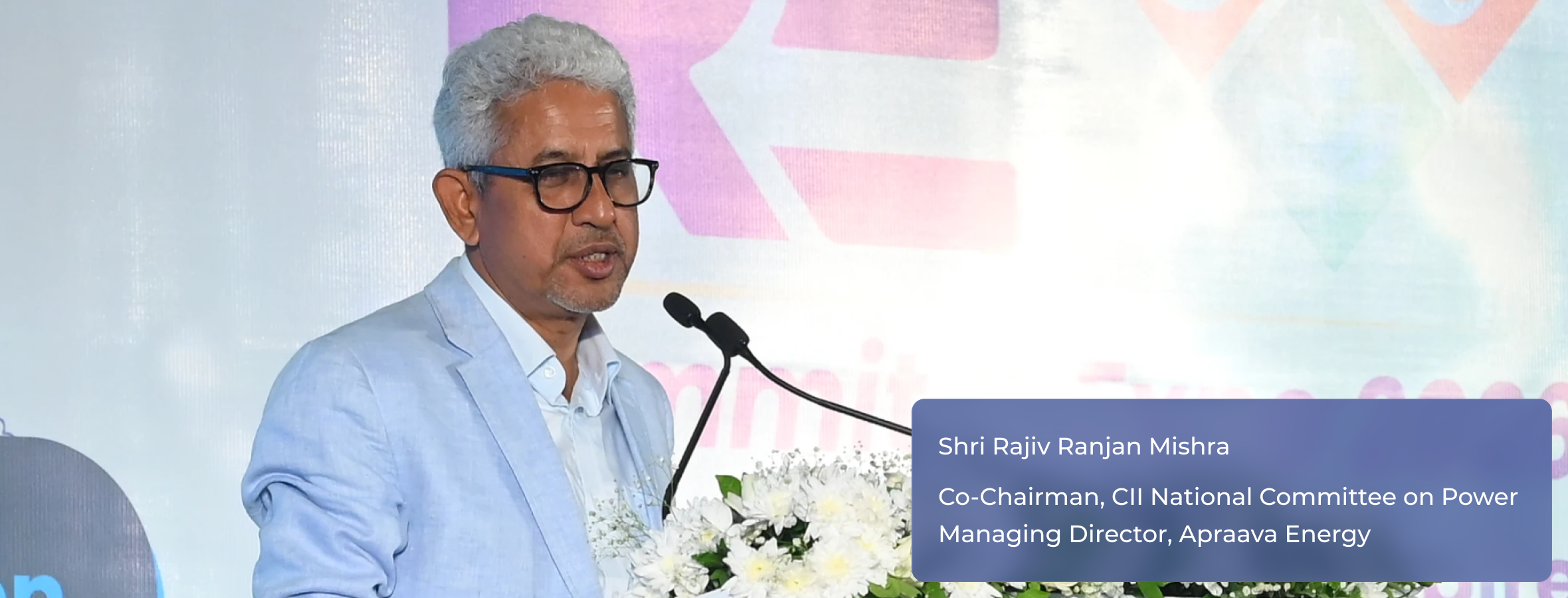
Shri Rajiv Ranjan Mishra
Co-Chairman, CII National Committee on Power | Managing Director, Apraava Energy
Sometimes the scale of a transformation becomes clearest when viewed from where the journey began.
Shri Rajiv Ranjan Mishra recalled that barely fifteen years ago, the Jawaharlal Nehru National Solar Mission was working towards a 20 GW solar target by 2020. India is now operating at an entirely different order of magnitude.
He cited nearly 300 GW of renewable/non-fossil capacity, around 138 GW under construction and roughly 40 GW of rooftop solar, placing the 500 GW by 2030 goal “within striking range”.
Mishra also noted that non-fossil sources were already contributing around a quarter of electricity generation and that, during periods in July 2025 and July 2026, variable renewable energy supplied more than half of the grid.
For him, that changes the strategic meaning of renewable energy: it is no longer simply about greening the grid; it is increasingly central to energy security and energy independence.
The next investment wave will therefore include dispatchable and round-the-clock renewable power, storage and the transmission infrastructure required to move that power reliably.
He also highlighted the world's largest smart-meter rollout programme—250 million meters—not merely as a billing intervention, but as infrastructure that can eventually give consumers more control over when and how they use electricity.
Manufacturing is another opportunity. Mishra pointed to India's domestically led wind sector, the rapid build-out of solar-module and cell manufacturing, and the possibility of repeating that trajectory in batteries and green hydrogen.
His appeal to Mumbai was therefore direct: this transition needs capital, ideas and policymakers in the same room.
Few generations, he suggested, get the chance to watch—and help build—the transformation of an entire national energy system.
For India's financial capital, BRESE 2026 is an invitation to participate in that transformation, not simply observe it.