

10 October 2026


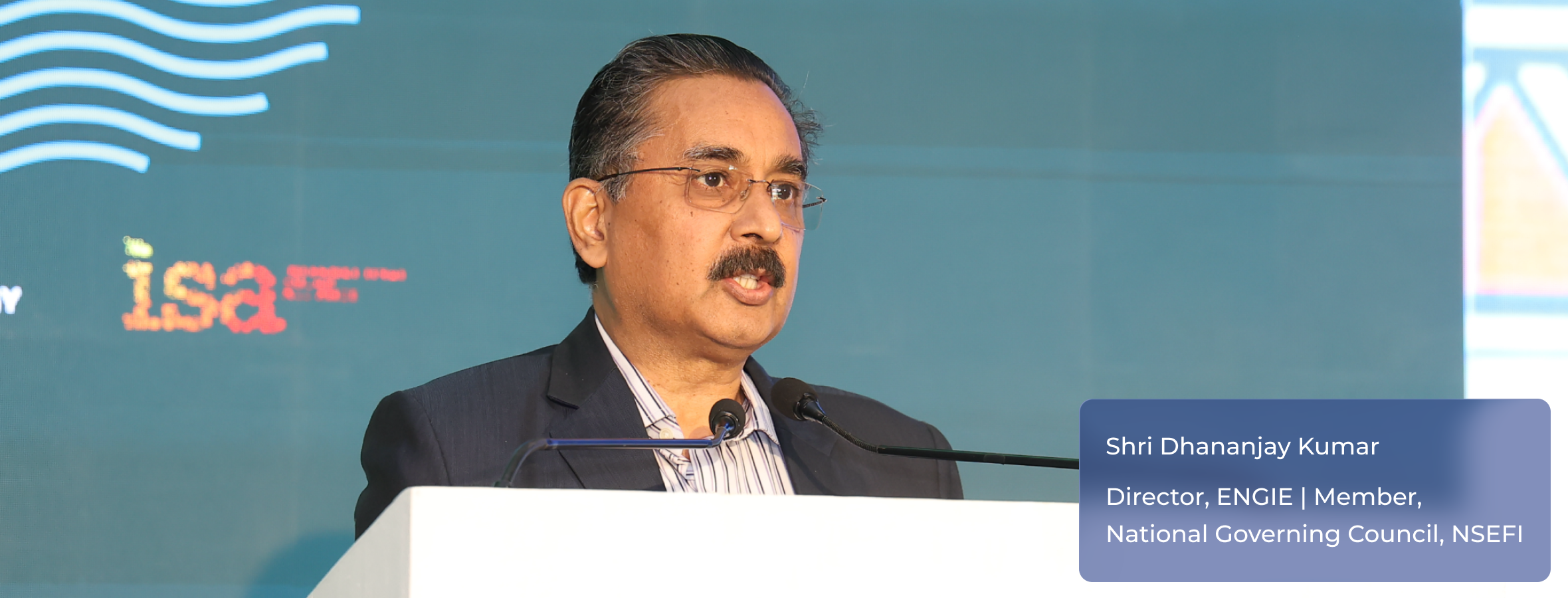
Shri Dhananjay Kumar
Director, ENGIE | Member, National Governing Council, NSEFI
As renewable-energy capacity expands, the challenge facing India is changing.
The country still needs new clean-energy projects. But the next phase will increasingly depend on whether the electricity system around those projects becomes flexible enough, reliable enough and commercially robust enough to absorb renewable energy at scale.
That implementation perspective framed the context-setting remarks of Shri Dhananjay Kumar, Director, ENGIE and Member of NSEFI’s National Governing Council, at the Ahmedabad Roadshow.
His intervention focused on the opportunities and practical challenges shaping the next phase of India’s energy transition, reinforcing the importance of continued dialogue between policymakers, regulators, developers and investors. ENGIE’s account of the Ahmedabad programme similarly describes his contribution as examining the opportunities and challenges emerging as renewable energy scales.
The distinction is important.
Renewable-energy growth cannot now be measured only in new solar panels or wind turbines.
As penetration increases, the system must solve for grid reliability, flexibility, energy storage, hybrid renewable configurations and the changing profile of electricity demand.
Policy and regulation are fundamental to that process. Kumar has consistently emphasised that electricity is a highly regulated business and that long-term policy and regulatory certainty is essential for investment. The relationship between government, regulators, professional bodies and project developers therefore becomes part of the infrastructure of the transition itself.
Gujarat provides an appropriate setting for that conversation.
Its renewable-energy ecosystem is already shifting from straightforward capacity addition towards questions involving transmission planning, grid strengthening, storage, hybrid projects, land and connectivity, operational efficiency and investor-friendly frameworks—the same practical issues discussed by industry and government in Ahmedabad around the roadshow.
This is where private-sector experience becomes especially valuable.
Companies developing renewable assets encounter the implementation realities behind policy: grid availability, project timelines, regulatory frameworks, market structures and increasingly the requirement to deliver renewable electricity when customers actually need it.
BRE Summit 2026 can help bring those operational realities into a larger policy, technology and investment dialogue.
India has proved it can add renewable-energy capacity at enormous scale.
The next test is building an energy system capable of using that capacity intelligently.
That transition, from more renewable power to a smarter renewable-power system, is where the next chapter begins.