

10 October 2026


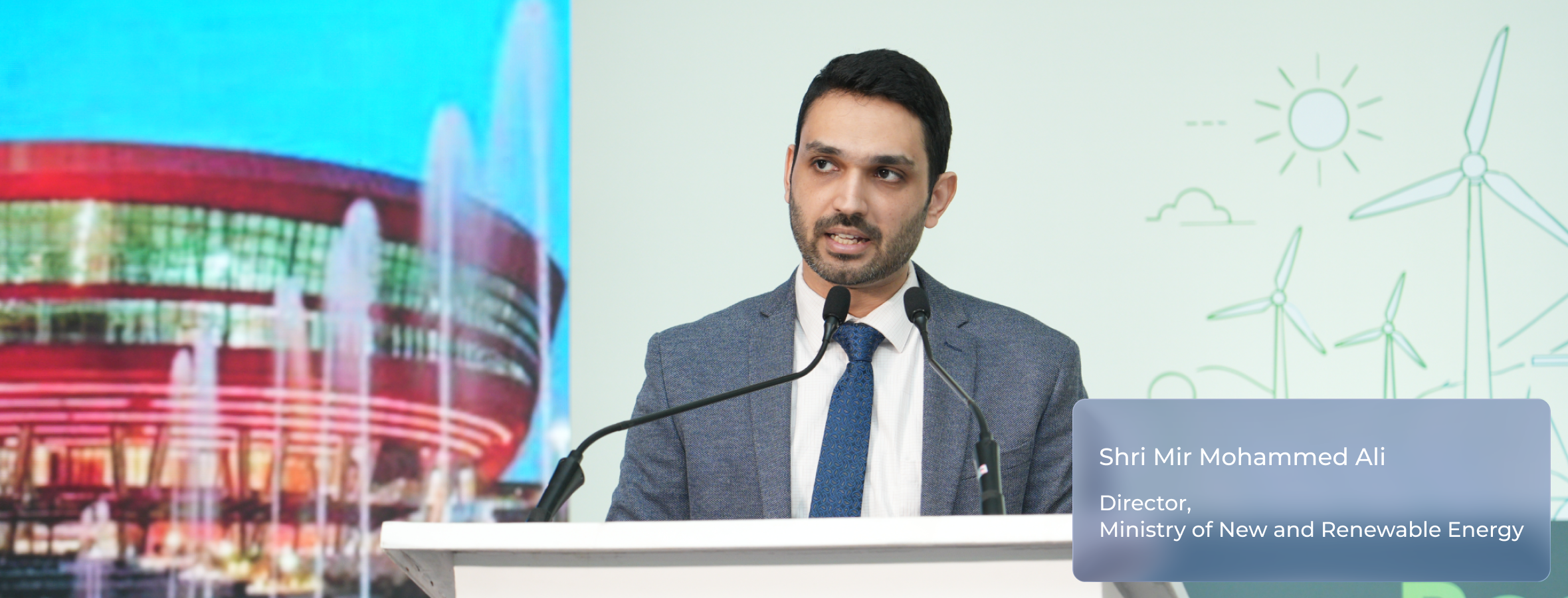
At the Bengaluru Roadshow for Bharat Renewable Energy Summit & Expo 2026, Shri Mir Mohammed Ali, Director, Ministry of New and Renewable Energy, used a series of figures to demonstrate how rapidly India’s clean-energy system has changed.
Shri Mir Mohammed Ali
Director, Ministry of New and Renewable Energy
India’s renewable-energy growth has been remarkable in scale.
Its real story, however, may lie in its speed.
At the Bengaluru Roadshow for Bharat Renewable Energy Summit & Expo 2026, Shri Mir Mohammed Ali, Director, Ministry of New and Renewable Energy, used a series of figures to demonstrate how rapidly India’s clean-energy system has changed.
He cited approximately 292 GW of installed renewable-energy capacity, placing India among the top three renewable-energy markets globally after China and the United States.
But the more revealing number was what happened within that total.
Approximately 216 GW or 74% of the present capacity has been added during just the last decade.
And approximately 101 GW has been added in the last two years alone.
The technology-specific numbers tell the same story.
Between 2014 and 2026, India’s solar capacity expanded approximately 53 times.
Wind capacity, meanwhile, tripled over the same period.
For Ali, this pace demonstrates that India’s renewable growth has moved far beyond incremental change.
It represents a structural transformation.
He attributed that acceleration to three mutually reinforcing foundations: a clear national framework, ambitious targets and sustained policy action.
At the centre stands India’s ambition of reaching 500 GW by 2030.
But a national target by itself cannot create markets. It needs mechanisms capable of translating ambition into demand and investment.
Ali highlighted renewable-energy consumption requirements, policy support around the Inter-State Transmission System (ISTS) and India’s push under the National Green Hydrogen Mission as examples of the ecosystem being built around the target.
The significance of this architecture becomes clearer as renewable penetration rises.
India is no longer building an industry around one technology. Solar, wind, storage, transmission, hydrogen, manufacturing and new forms of renewable-energy consumption increasingly form parts of a connected system.
That interconnected opportunity is also what BRE Summit 2026 seeks to place on a global stage.
For businesses and investors, the numbers presented in Bengaluru reveal two things simultaneously.
India has already built enormous renewable-energy scale.
But much of that scale is remarkably recent.
When 74% of capacity can be added within a decade and 101 GW within only two years—the direction of travel becomes difficult to miss.
India’s renewable-energy transition is not simply continuing.
It is accelerating.