

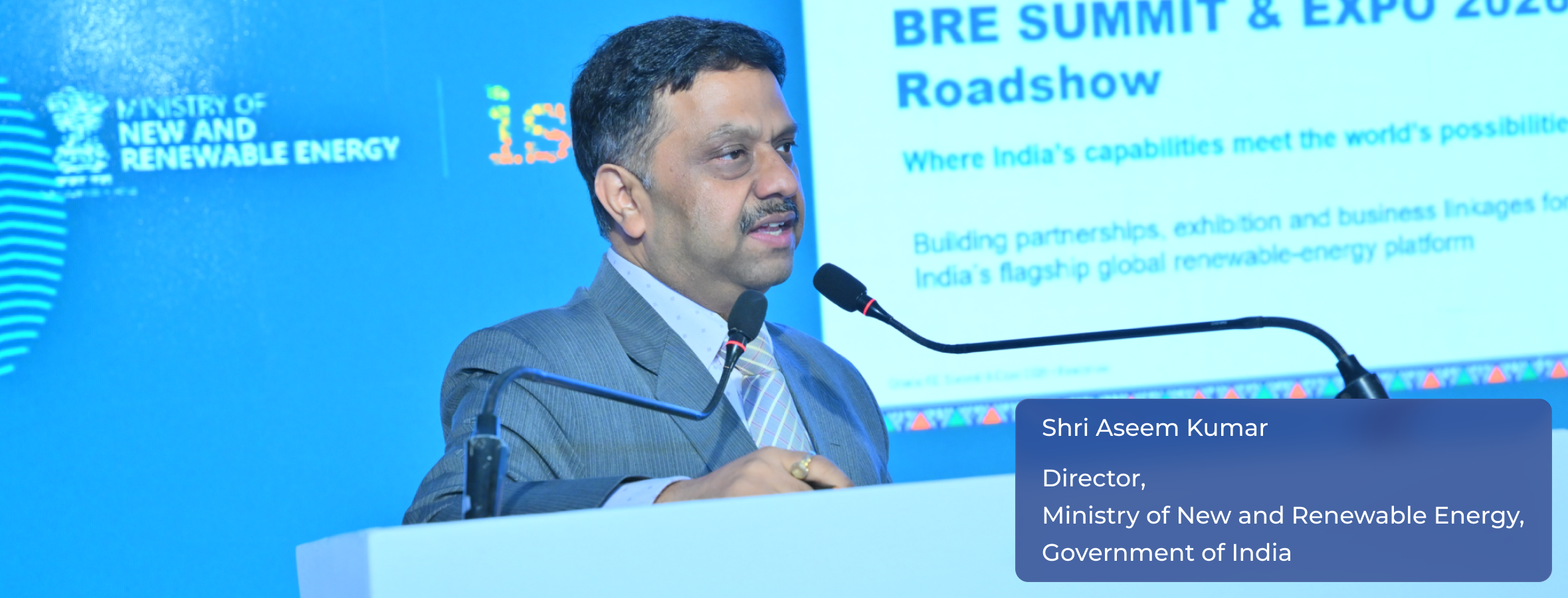
11 October 2026


Shri Aseem Kumar
Director, Ministry of New and Renewable Energy, Government of India
Shri Aseem Kumar presented India’s renewable-energy story as a market that is both large and accelerating, while using the Lucknow Roadshow to invite Uttar Pradesh’s industry and State Government into BRE Summit 2026.
As of July 2026, he placed India’s installed renewable-energy capacity at about 292 GW—nearly four times the 2014 level—with about 101 GW added in the previous two years.
He said India ranked third globally in installed renewable-energy capacity, third in solar and fourth in wind.
Kumar attributed that expansion to a combination of supportive Central and State policies, innovative business models, an investor-friendly environment and the creation of robust domestic manufacturing capacity.
He cited PM Surya Ghar, PM-KUSUM, Green Energy Corridors, the National Green Hydrogen Mission, ISTS-related policy support, renewable purchase obligations and the manufacturing ecosystem as parts of that enabling architecture.
Looking to 2030, his presentation envisaged around 300 GW of solar and about 100 GW of wind within India’s broader 500 GW ambition, requiring significant investment across states including Uttar Pradesh.
He quantified the wider national investment requirement at roughly US$300–350 billion—around ₹30–32 lakh crore—by 2030, and positioned BRE Summit as a platform for mobilising that capital.
For industry, Kumar described the Summit as a route to policymakers, state governments, international delegations, utilities, developers, investors and technology providers, while also enabling manufacturing showcases, partnerships and technology transfer.
He said the objective was not only visibility but tangible outcomes, including partnerships and potentially finalising MoUs during the Summit, supported by the dedicated website and application.
The underlying proposition from his presentation was straightforward: India’s next renewable leap will require capital at the same scale as its capacity ambition.